



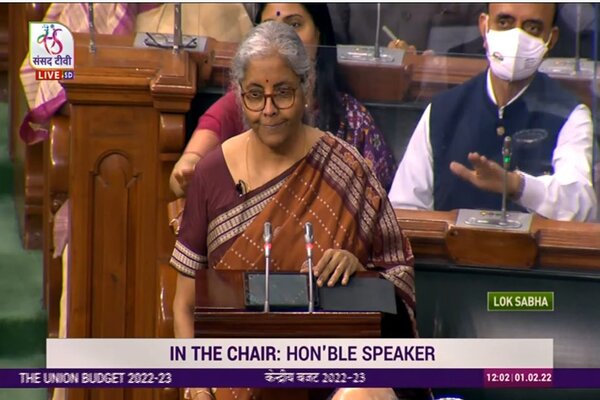
Finance Minister Nirmala Sitharaman, while presenting the Union Budget, said that the Union Budget seeks to lay the foundation and give a blueprint of the economy over ‘Amrit Kal’ of next 25 years – from India at 75 to India at 100.
She said that the country is expected to grow at 9.27 per cent in the coming year. With a focus on four pillars of development — inclusive development, productivity enhancement, energy transition and climate action — the Budget gives a blueprint of the economy from India at 75 to India at 100, Sitharaman said.
The Budget estimates the effective capital expenditure of the Central government at Rs 10.68 lakh crore in 2022-23, making up about 4.1 per cent of the GDP. The Economic Survey, tabled on Monday, pointed out that buoyant tax revenues offered the government fiscal space to provide additional support to the economy and continue the push in favour of higher capital expenditure.
Highlighting that there was a sharp increase in public investment and capital expenditure in the last budget, the minister added that Budget 2022-23 will benefit youth, women, farmers, and SC & ST. “Moving forward on this parallel track, we lay the following four priorities – PM Gati Shakti, inclusive development, productivity enhancement and investment, sunrise opportunities, energy transition and climate action,” said Sitharaman.
In a major push for digital currency, Sitharaman stated that digital rupee will be issued using blockchain and other technologies by the RBI starting 2022-23. This will give a big boost to the economy, the Finance Minister said.
For 2022-23, allocation of Rs 1 lakh crore has been made to assist the states in catalysing overall investments in the economy. These 50-year interest-free loans are over and above normal borrowings allowed to states. It’ll be used for PM Gati Shakti-related and other productive capital investments of states, she added.
To facilitate domestic manufacturing of 280 gigawatt of installed solar capacity by 2030, additional allocation of Rs 19,500 crore for PLI for manufacturing of high-efficiency modules with priority to fully integrate manufacturing units to solar PV modules will be made.
68% of the capital procurement budget for Defence to be earmarked for domestic industry to promote Aatmanirbharta and reduce dependence on imports. This is up from the 58% last fiscal. Issuance of e-passports will be rolled out in 2022-23 to make it easier for citizens, she added.
Finance Minister announced that over 2,000 km of rail network to be brought under the indigenous world-class technology KAWACH, for safety and capacity augmentation. 400 new Vande Bharat trains with better energy efficiency and passenger riding experience to be manufactured in the next three years.
She also said that an open platform for the National Digital Health Ecosystem will be rolled out. It will consist of digital registries of health providers and health facilities, unique health identity and universal access to health facilities The pandemic has accentuated mental health problems in people of all ages. To better the access to quality mental health counseling and care services, a National Tele Mental Health program will be launched.
A fund with blended capital raised under co-investment model facilitated through NABARD to finance start-ups in agriculture and rural enterprises for farm produce value chain will be set up. States will be encouraged to revise syllabi of agricultural universities to meet needs of natural, zero-budget and organic farming, modern-day agriculture, she added.
Procurement of wheat in Rabi season 2021-22 and the estimated procurement of paddy in Kharif season 2021-22 will cover 1,208 lakh metric tonnes of wheat and paddy from 163 lakh farmers & Rs 2.37 lakh crores will be the direct payment of MSP value to their accounts: FM Sitharaman
She proposed the Production Linked Incentive Scheme for achieving Aatmanirbhar Bharat has received an excellent response, with potential to create 60 lakh new jobs and additional production of 30 lakh crore during the next five years.
Nirmala Sitharaman proposed use of drones to be promoted for crop assessment, digitization of land records, spraying of insecticides and nutrients. Fund to be facilitated through NABARD to finance start-ups for agriculture and rural enterprise which are relevant for the farm produce value chain.
