



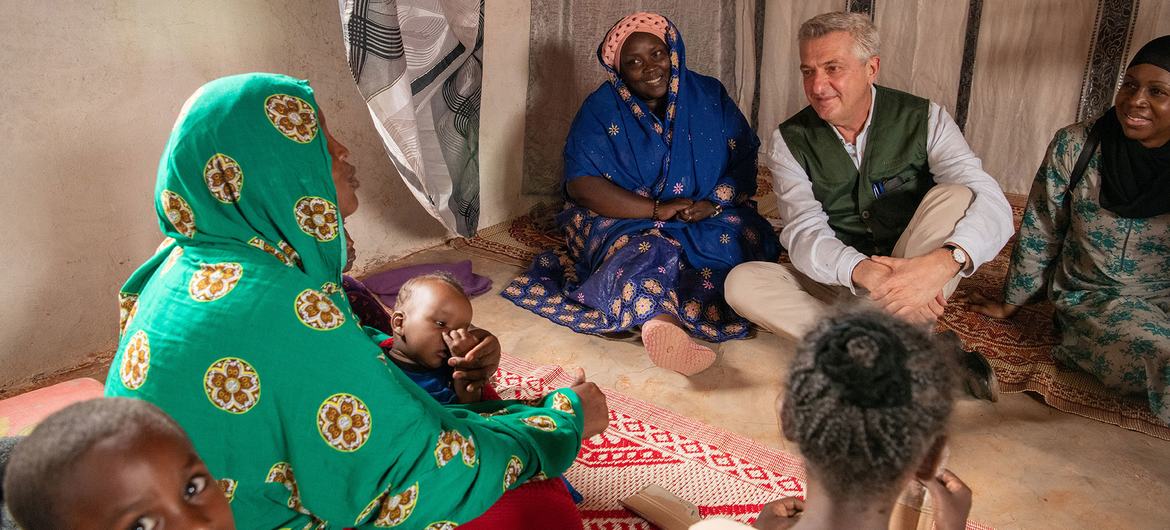
Responses to climate change must also consider its link to both conflict and the displacement it causes, UN High Commissioner for Refugees, Filippo Grandi, said in a briefing to the Security Council. He expressed hope that these dimensions “will be in clearer focus” at the COP27 UN climate change conference, opening this weekend in Egypt, and at its successor conference in a year’s time.
The climate emergency is ravaging resources and creating tensions, including between communities, particularly in already fragile contexts where authorities do not have the means to support adaptation and resilience.
“I fear that without more attention and much greater financing for prevention, adaptation, and development and governance support – tensions, frustrations, competition will grow and spark wider conflict, with deadly consequences – including displacement,” he said.
The UN refugee chief was in Somalia last week where he met emaciated women, men and children affected by conflict and the historic drought in the Horn of Africa. Refugees from the country have been pushed into drought-affected areas of neighbouring Kenya.
“The confluence of climate change and conflict has created very protracted displacement: therefore, inclusion and where possible integration, both in refugee contexts and situations of internal displacement, are important peacebuilding measures requiring greater international recognition and support,” Grandi told the Council.
This “spiral” is evident in several other hotspots, including Africa’s Sahel region, he added. Three million people there have been uprooted by climate change, poverty, weak governance and armed group activities, as well as “the often brutal reaction of governments”.
Globally, roughly 103 million people have been forcibly displaced by persecution, conflict, violence, human rights violations and other factors. UNHCR staff have responded to 37 emergencies around the world in the past 12 months alone, in countries such as Afghanistan, the Democratic Republic of the Congo, Ethiopia, Myanmar and Syria.
Meanwhile, Russia’s invasion of Ukraine has forced some 14 million people to flee their homes, sparking the fastest and largest displacement crisis in decades.
“Ukrainians are about to face one of the world’s harshest winters in extremely difficult circumstances. Humanitarian organizations have dramatically scaled up their response, but much more must be done, starting with an end to this senseless war,” he said.
“Unfortunately, we see the opposite, and the destruction caused by strikes at civilian infrastructure, which happens as we speak, is quickly making the humanitarian response look like a drop in the ocean of needs.”
