



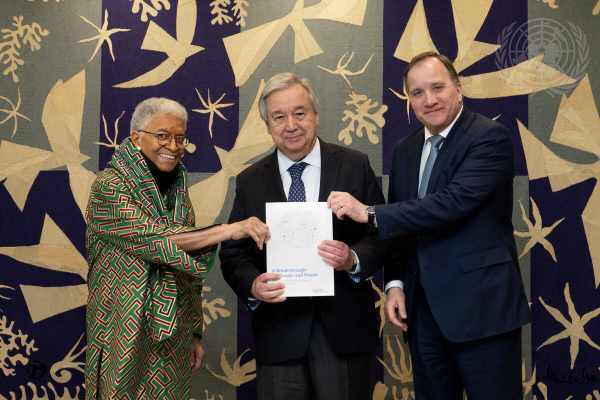
Last week, the UN chief was presented with a report by a High-Level Advisory Board which he had set up to propose measures to make multilateralism more effective. The document titled “Breakthrough for People and Planet” puts forward numerous recommendations that relate to six “transformative shifts” the panel believes will “help tackle the challenges facing us today and those on the horizon.”
The report highlights the need of “rebuilding trust” in multilateralism through “inclusion and accountability”, “regaining balance with nature and providing clean energy for all”, ensuring “sustainable finance”, a “just digital transition”, “effective collective security arrangements” as well as strengthening governance of “current and emerging transnational risks”.
According to the panel, in short HLAB, these “shifts” need to be based on “ten constituent principles of multilateralism” which it says are “people-centered, representative, transparent, equitable, networked, resourced, mission-focused, flexible, accountable, and future oriented.”
In the field of “rebuilding trust”, the document stresses that the multilateral system should be “people-centered” and that this requires it to be “radically and systematically inclusive”.
It says that “meaningful opportunities” are needed for “participation in global decision-making by all states, civil society, private sector actors, local and regional governments, and other groups that have been traditionally excluded from global governance”.
However, Democracy Without Brooder’s (DWB) deplored that no consideration of involving citizens and elected representatives Among other things, the document suggests that cities and subnational regions could be directly involved in global governance “without diluting the central role played by states”.
The same is suggested for the private sector whose direct involvement was “an unavoidable aspect of more effective multilateralism” according to the panel. Civil society inclusion could be facilitated by a “network of formally recognized civil society focal points” across the UN.
Democracy Without Borders, a civil society organization that promotes global democracy, better global governance, and global citizenship, commented that the report puts forward “important goals that deserve full support” such as advancing gender equality, giving more voice to civil society, refugees and forcibly displaced people, children and youth. Further, the panel’s call for shifting away from an “overreliance on decisions by consensus” to qualified majorities was “spot on”.
According to the group’s Executive Director, Andreas Bummel, there was a “critical gap” in the report, however. “Citizens and their elected representatives are the original source of legitimacy. They are more than just some stakeholders one can forget about”, he said. “We regret that the panel failed to recognize this”, he commented, adding that “the report is silent on how to better involve citizens and parliamentarians at the UN and in multilateral processes.”
This is not how you rebuild trust With this in mind, the panel’s recommendations on strengthening the role of the private sector were “concerning”. “In our view it is unbalanced to call for corporations to have a seat at the table and at the same time ignore the need of citizen participation and representation. This is not how you rebuild trust”, Bummel stated.
