



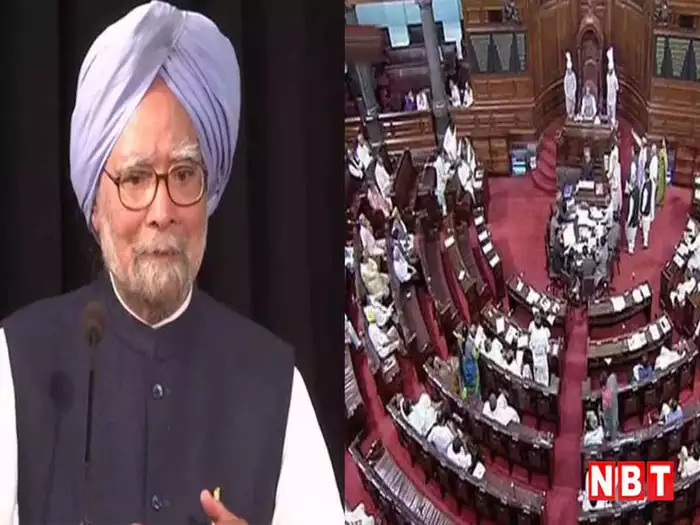
It is finally former Prime Minister Manmohan Singh ends his eventful parliamentary career, who retires from the Rajya Sabha on Wednesday after six terms and a stint of 33 years that witnessed his phenomenal rise to the position of India’s Prime Minister.
Singh (92) was first elected to the House of Elders in October 1991 soon after he assumed charge as Union Finance Minister in June that year. A prime example of lateral entry into the government when such switches were few and far between, leading economist Singh’s first engagement with the Union Government was as economic adviser to the Ministry of Foreign Trade between 1971 and 1972.
There was no looking back for the Gah-born economist who broke barriers to chart an exceptional career, surprising colleagues and critics alike. Soon after his maiden assignment with the government in 1971, Singh found himself elevated as chief economic adviser to the Ministry of Finance until 1976, steadily rising up the ladder through the subsequent years to become—Director, RBI (1976-1980); Secretary, Ministry of Finance (1976 to 1980); RBI Governor (1982 to 1985); Deputy Chairman, Planning Commission (1985 to 1987) and Adviser to the PM on economic affairs (1990-1991).
Singh’s political break came on June 21, 1991, when then Prime Minister PV Narasimha Rao handpicked him to serve as Union Finance Minister when India was struggling with the balance of payment crisis. Just before elevation as the Finance Minister, Singh was serving as the UGC Chairman in 1991. It was after this appointment that Singh was first elected to the Rajya Sabha in October 1991. He remained a RS MP from Assam and later Rajasthan.
Widely credited with economic liberalisation that unleashed India’s growth potential, Singh continued to transition from a suave economist to a deft politician, gaining the confidence of Sonia Gandhi, who assumed charge as Congress president in 1998.
She tasked Singh with the role of Leader of Opposition in the Rajya Sabha from 1998 to 2004 and when it came to vacating her claim over prime minister-ship in May 2004, she handpicked Singh to become India’s Prime Minister, a post in which he served from May 22, 2004, to May 26, 2014, when the Narendra Modi-led BJP dislodged the Congress-led UPA from power.
Singh was never elected to the Lok Sabha. He had contested the South Delhi parliamentary poll in 1999 as the Congress candidate, but lost to BJP stalwart VK Malhotra. Bidding farewell to the veteran parliamentarian in the last session of the RS, Modi had hailed Singh’s role in strengthening the Indian democracy.
