



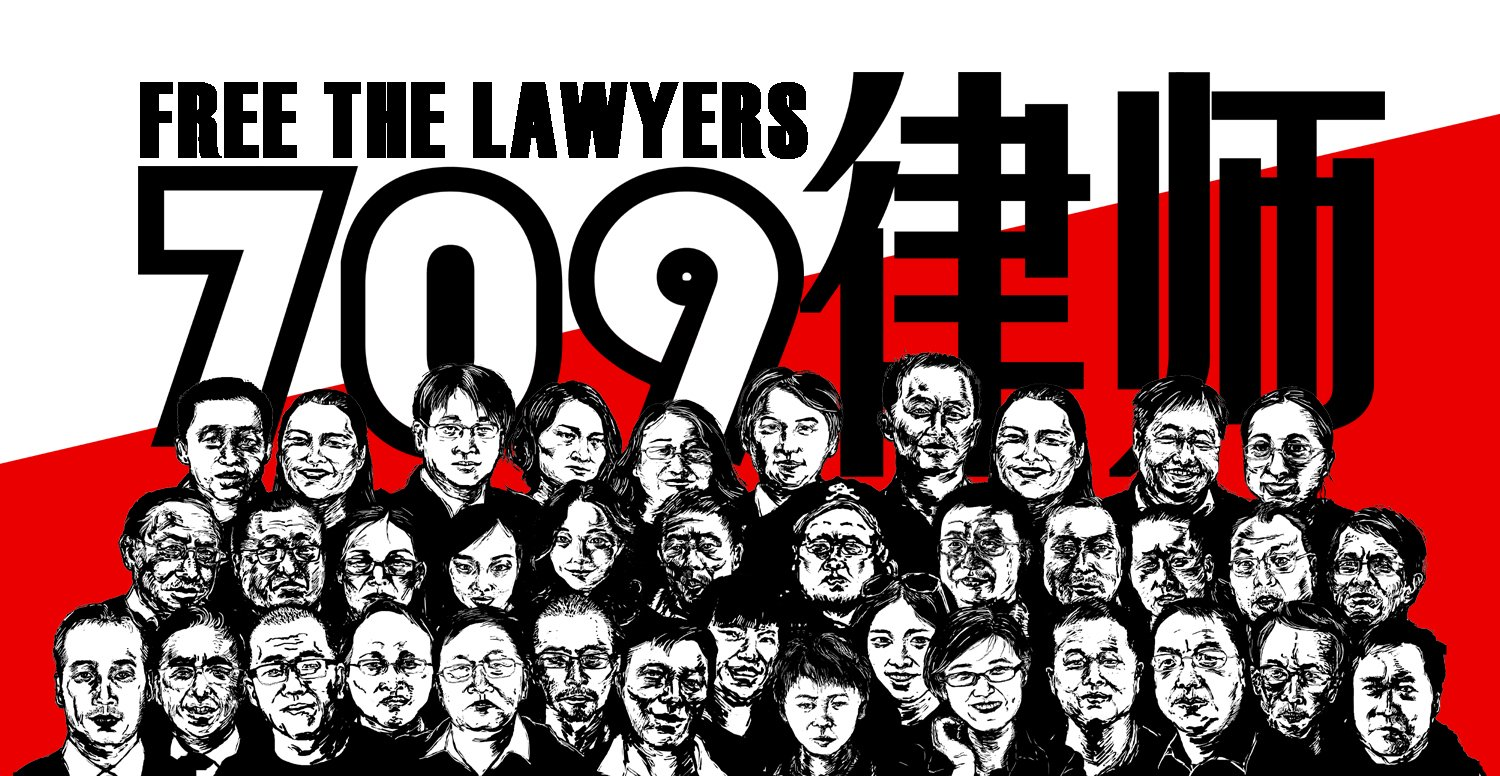
June 10 marks China Human Rights Lawyers Day, in remembrance of the Chinese government’s roundup of over 300 human rights lawyers and legal assistants in the days following July 9, 2015, in what is known as the ‘709 crackdown’. UN experts are dismayed that ‘the profession of human rights lawyer has been effectively criminalised in China.’
Human rights lawyers are at a cornerstone of China’s human rights movement. From Uyghurs, Tibetans and Hong Kongers, to religious minorities, LGBTQI and feminist advocates, journalists, and political dissidents: human rights lawyers defend the full spectrum of civil society. They accompany and empower the most vulnerable against land evictions, discrimination, health scandals, or extra-legal detention.
They embody the promise of rule of law and hold the government accountable to its commitments under China’s constitution, laws, and the international human rights treaties it has ratified. They ensure that no one is left behind. On this day, several global organisations called for urgent global attention to the Chinese government’s new wave of repression against human rights lawyers unfolding over the past three months.
They strongly condemn the Chinese government’s abuse of national security, in law and practice, to target human rights lawyers and activists, as documented by UN experts. The authorities make systematic use of national security crimes under China’s Criminal Law, in particular ‘subversion of State power’ or ‘inciting subversion’ (Article 105) that carry lengthy prison sentences.
According to UN human rights experts, China’s Criminal Procedure Law, including Articles 39 and 85, ‘provides for explicit exemptions and restrictions to [legal provisions guaranteeing due process] for national security crimes, such as notification of family members of arrest within 24 hours, or access to a lawyer within 48 hours.’
UN experts have called on China to repeal Article 105 of the Criminal Law, and legal provisions allowing for RSDL. In 2015, the UN Committee Against Torture called on China to repeal restrictions to the right to counsel and to family notification on national security grounds.
They further expressed concern that the Hong Kong authorities are following a similar path since the imposition of the National Security Law. They remain deeply concerned at the Chinese government’s increasing use of exit bans to impede human rights lawyers and activists from leaving the country, sometimes to visit a critically ill relative. They are alarmed at the severe harassment against released human rights lawyers and their relatives, including children.
They also urge greater attention to the Chinese government’s disbarment of human rights lawyers. At least 30 human rights lawyers have seen their practising license suspended or revoked by the authorities since 2017.
Detained human rights lawyers are constantly subject to physical and psychological torture and ill-treatment in pre-trial detention and prison. They are routinely denied contact with their relatives and access to medical care, despite critical health issues.
The government impedes family-appointed lawyers from accessing court documents and representing victims, instead imposing government-appointed lawyers whose identities are not disclosed or refuse to communicate with relatives. Detained lawyers are often convicted during sham closed-door trials, without notification to families nor disclosure of court verdicts for prolonged periods.
The UN Working Group on Arbitrary Detention has determined that China has a ‘systemic problem with arbitrary detention which amounts to a serious violation of international law’. Over the years, sustained attention from the international community has contributed to the release and improvement of conditions for those detained, and brought lawyers and relatives vital moral support.
Against this new wave of repression, which has been known as the ‘709 crackdown 2.0’, they urged the international community to urge the Chinese government to:
- Put an end to its crackdown on human rights lawyers and defenders;
- Immediately and unconditionally release all those arbitrarily detained;
- Amend laws and regulations, including national security legislation, its Criminal Law and Criminal Procedure Law, to bring them into full compliance with international human rights standards; and meaningfully cooperate with the United Nations human rights bodies to that end.
