



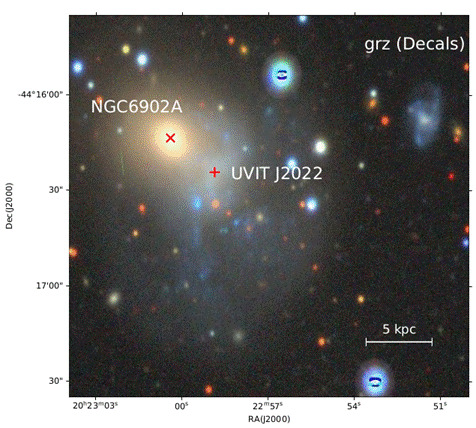
Researchers have discovered a faint but star-forming galaxy, around 136 million light-years away which was so far undetected since it lies in front of a much brighter galaxy, The galaxy has a ‘ghost’ like appearance in the optical images because of its low disk density, but the inner disk shows star formation.
The inner disk star formation helped its detection in UV and optical images. An accurate census of such faint galaxies is essential to measure the total mass of all objects made normal atomic matter (stars and gas) in the Universe.
As optical telescopes have become more and more powerful, they are sensitive enough to detect galaxies that are extremely faint. Such galaxies are called low surface brightness galaxies or ultra-diffuse galaxies and have a surface brightness that is at least ten times fainter than the surrounding night sky. Such faint galaxies may account for up to 15 % of the mass of the universe. However, they are difficult to detect because of their inherent low luminosities.
A team of researchers from the Indian Institute of Astrophysics, Bengaluru consisting of Jyoti Yadav, Mousumi Das and Sudhanshu Barway, along with Francoise Combes of College de France, Chaire Galaxies et Cosmologie, Paris, while studying a known interacting galaxy NGC6902A noticed that the colour image (Dark Energy Camera Legacy Survey (DECaLS) colour image) of the south-west outer region of the galaxy NGC 6902A in the shows diffuse blue emission.
DECalS is a deep optical survey conducted on international telescopes that can be used to detect diffuse galaxies. This south-western region shows prominent star-forming regions in the Far Ultraviolet (FUV) image. Most of the FUV emission in galaxies is due to young stars of types O and B —the most massive stars and also the most short-lived in the galaxies.
But they emit FUV light for 100 million years which is comparatively long compared to the other star formation tracer. This excess FUV light prompted the researchers to investigate the peculiar feature in more detail to determine the cause of the interaction.
The researchers measured the distance of NGC6902A, a previously known galaxy and the faint star-forming regions using emission lines in the spectra. They found that these star-forming regions are at a distance of around 136 million light-years, whereas the distance of NGC 6902A is around 825 million light-years.
