



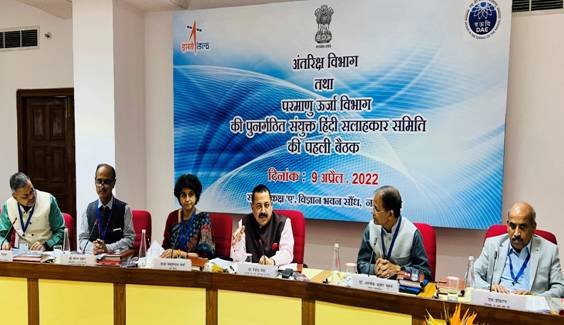
Union Minister of State Science & Technology Dr Jitendra Singh today said that India’s Nuclear Programme is for improving quality of life and not for causing harm to human life.
He said that India has covered a long journey since the inception of the Atomic Energy programme by Dr Homi Bhabha based on the peaceful use of nuclear energy. He said that time has come to renew the noble pledge of Dr Bhabha as “Sankalp se Siddhi”.
He was chairing the meeting of the reconstituted Joint Hindi Salahkar Samiti of Department of Atomic Energy and Department Space at Vigyan Bhawan in New Delhi.
He said that applications of nuclear energy and radiation have played a significant role in the field of electricity production, agriculture, medicine, health, food preservation, improved seeds varieties, water purification technologies, urban waste management technologies, industrial application of radioisotopes and radiation technologies particularly in petroleum industry.
He, however, lamented that most of the societal applications of nuclear energy are not much known to the people. The Minister also informed that Gamma Irradiation Technology is used for inhibition of sprouting in bulbs and tubes, insect disinfestation of cereals, pulses and grains, microbial decontamination (hygienization) of dry spices etc., for preservation/shelf life extension by applying pre-determined radiation doses.
He said, even during COVID pandemic, the Department of Atomic Energy (DAE) came out with novel innovations like COVID BEEP, India’s first indigenous, cost effective, wireless physiological parameters monitoring system for COVID-19 patients. Dr Jitendra Singh said that Tata Centre Mumbai, which is running a number of Cancer Hospitals across the country works under the aegis of the Department of Atomic Energy. He also informed that the Department of Atomic Energy and Tata Memorial Centre, with assistance from Tata Trust, is setting up additional units In Bihar, Assam and Uttarakhand
