



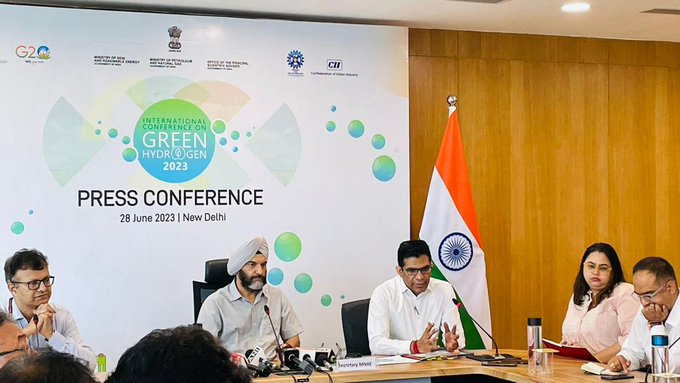
On the eve of the three-day International Conference on Green Hydrogen (ICGH-2023), a press conference was conducted to showcase India’s enormous investment in green hydrogen and its revolutionary impact on the country’s energy landscape.
The Union Ministry of New and Renewable Energy Secretary, Bhupinder S Bhalla, emphasised the conference’s complete coverage of the full green hydrogen ecosystem, including production, storage, mobility, utilisation, distribution, infrastructure, and transportation. The goal of ICGH 2023 was to learn from the experiences of other countries that are leading the development and implementation of green hydrogen.
Dr. Ashish Lele, Director of the National Chemical Laboratory in Pune, emphasised the developing nature of green hydrogen and the conference’s goal of bringing together key stakeholders to discuss crucial issues in the industry. He emphasised the indigenous innovations on display at ICGH-2023, such as the fuel sim technology exhibit developed cooperatively by DRDO, L&T, and KPIT.
Dr. SSV Ramakumar, Director (R&D) of Indian Oil Corporation Limited (IOCL), expressed satisfaction with the conference’s achievement of exploring prospects for boosting green hydrogen through the sharing and learning of international best practices. He highlighted IOCL’s plans to introduce 15 fuel cell-powered buses in Delhi this year, with routes connecting Faridabad-Delhi, Delhi-Agra, and potential extensions to locations such as Baroda-Kevadia and Trivandrum-City Centre.
Academic associations, private universities, and organisations such as India Energy Storage Alliance (IESA) and Council of Scientific and Industrial Research (CSIR) are working to develop unique courses and skilling programmes. The Ministry of Skill Development and Education is also developing a policy to give hands-on training in various sectors of the green hydrogen ecosystem.
According to Bhalla, India wants to create 5 million metric tonnes of green hydrogen by 2030, with 70% slated for exports and the remaining 30% for local consumption. Five priority sectors for green hydrogen applications have been selected, including fertiliser, refinery, and long-haul mobility (with pilots already in place in industries like as steel, shipping, and long-haul transportation).
Over 2,700 people registered for the three-day conference, which included speakers from Japan, Australia, Africa, and the European Union. The conference featured seven plenary sessions, four panel discussions, and sixteen technical sessions.
A separate CEO roundtable, headed by Union Minister for Power and New and Renewable Energy, R K Singh, presented an opportunity to examine the potential opportunities in India’s green hydrogen ecosystem. In addition, closed-door country roundtables with Singapore, Korea, Japan, and the EU were organised to discuss the prospects for partnership for mutual benefit.
