



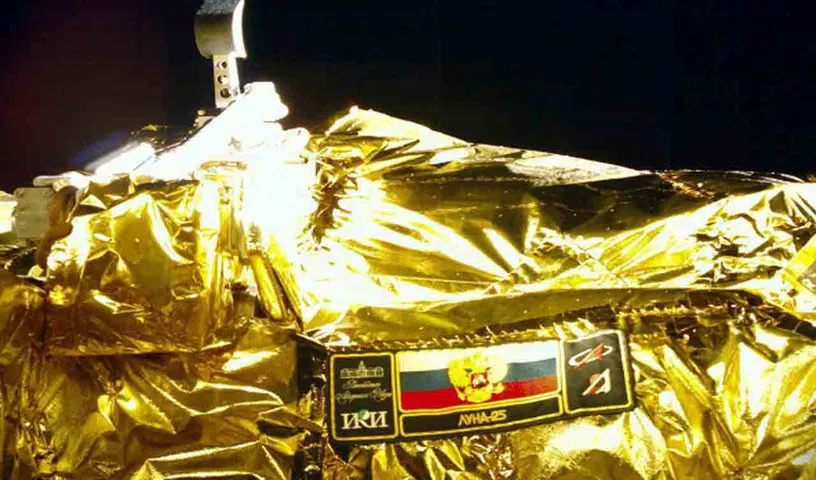
Russia’s failed attempt to set foot on the South Pole of the Moon, which no one has been to before. Much later than India’s Chandrayaan 3, the Russian space research agency Roscosmos launched a spacecraft named Luna-25. It was also supposed to land on the south pole of the Moon and conduct research like the Acham Chandrayaan 3 mission.
However, Luna 25 is scheduled to land on the South Pole on August 21 as per the earlier schedule. However, the Luna 25 spaceship, which successfully entered the moon’s orbit, failed to meet the expectations. Roscosmos announced that it had crashed on the surface of the moon.
This is the first time in almost 50 years that Russia has launched the Luna 25 spacecraft to investigate Zabilli. However, the Luna 25 spacecraft is scheduled to land on the South Pole on August 21, two days earlier than Chandrayaan 3.
But the Russian space agency Roscosmos said on Sunday that Luna 25 crashed on the moon during some pre-landing procedures. Earlier on Saturday at 2.57 pm, Roscosmos said that they lost contact with Luna 25. It said that immediate action was taken.
According to the preliminary research, no information was received after the lander collided with the surface of the moon. It was in this sequence that the Luna 25 spacecraft was declared to have crashed.
The spacecraft blasted off from the Vostochny Cosmodrome at 2.10 am on August 10. But in just 5 days it reached Zabilli orbit which is 4 lakh km away. However, Luna 25, which reached the moon very quickly, suffered a technical error while entering the orbit. Roscosmos revealed that Luna 25 crashed a day after a technical problem.
However, Roscosmos Chief Yuri Borisov explained to Russian President Vladimir Putin about the experiments related to research on the moon. He said that such experiments are very dangerous. Only about 70 percent are successful.
The Luna 25 spacecraft stayed on the moon for a year, collecting samples, analyzing soil and conducting research. The cameras installed on the Luna 25 spacecraft lander have taken pictures of the Earth and the Moon from space and have already sent them back to Earth.
