



On March 1, Russia’s foreign minister Sergey Lavrov told the Conference of Disarmament in Geneva (which he attended virtually due to restrictions on air space) that “the threat that the (Volodymyr) Zelenskyy (in Ukraine) poses to neighbouring countries and international security in general have increased significantly after the Kyiv authorities started dangerous games involving plans to obtain their own nuclear weapons”.
Ukraine’s decision to give up nuclear weapons followed three years of national deliberations and with the US and Russia, and hefty security assurances by the three original Non-proliferation Treaty (NPT) powers — the US, Russia, and UK — and by France and China, too. This was buttressed by promises of non-expansion by NATO to assuage Russian concerns.
For more than two decades, Ukraine was seen as a model of non-proliferation, and an example of an ideal NPT signatory, at a time when India and Pakistan went nuclear, and the A Q Khan proliferation network put Pakistan at the centre of the scandal.
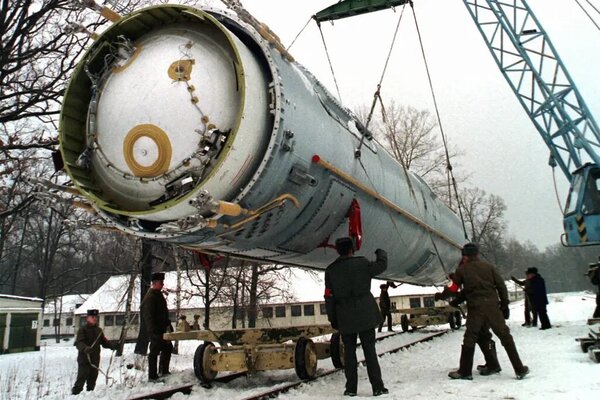
At the time of Ukraine’s independence from the Soviet Union in 1991, Ukraine held the third largest nuclear arsenal in the world, including an estimated 1,900 strategic warheads, 176 intercontinental ballistic missiles (ICBMs), and 44 strategic bombers.
By 1996, Ukraine had returned all of its nuclear warheads to Russia in exchange for economic aid and security assurances, and in December 1994, Ukraine became a non-nuclear weapon state-party to the 1968 nuclear Nonproliferation Treaty (NPT). The last strategic nuclear delivery vehicle in Ukraine was eliminated in 2001 under the 1991 Strategic Arms Reduction Treaty (START)
In Ukraine, the nuclear question is playing out very differently. Under an international agreement, and supervised by Russia and the United States, Ukraine had de-nuclearised completely between 1996 and 2001. Now, with invading Russian forces inside its borders, many Ukrainians are wondering whether it had been a mistake to de-nuclearise, and whether having nuclear weapons could have worked to deter Russia’s aggression against their country.
The biggest mistake Ukraine made was in 1994, when it decided to unilaterally surender its nuclear arsenal. Both Russia and the West had promised to respect and protect Ukraine’s sovereignty. And by 2014, those promises were not worth the paper they were written on.
Two recent strategic blunders
Experts say that the Russian invasion of Ukraine resulted from very recent two immense strategic blunders. According to veteran historian of Russia, a professor emeritus at St. Antony’s College, Oxford University, Robert Service, the first came on November. 10, when the U.S. and Ukraine signed a Charter on Strategic Partnership, which asserted America’s support for Kyiv’s right to pursue membership in the North Atlantic Treaty Organization.
The pact made it likelier than ever that Ukraine would eventually join NATO—an intolerable prospect for Vladimir Putin. “It was the last straw,” Service says. Preparations immediately began for Russia’s so-called special military operation in Ukraine.
The second strategic error was Putin’s underestimation of his rivals. “He despises the West and what he sees as Western decadence,” Service says. “He had come to believe that the West was a shambles, both politically and culturally.” He also thought that the leaders of the West were “of poor quality, and inexperienced, in comparison with himself. After all, he’s been in power 20 years.”
Ukraine’s security timeline
- July 16, 1990: Ukraine’s Declaration of Sovereignty
- July 31, 1991: The United States and the Soviet Union sign START
- Dec. 26, 1991: The Soviet Union officially dissolves, delaying entry into force of START
- Dec. 30, 1991: Minsk Agreement on Strategic Forces
- The Commonwealth of Independent States agrees that strategic forces would be under the joint command of the former Soviet Union states
- May 23, 1992: Russia, Belarus, Ukraine, Kazakhstan, and the United States sign the Lisbon Protocol
- The protocol calls for the return of nuclear weapons in three formerly Soviet states to Russia and for all states to be added to the START treaty and join the NPT
- Jan. 14, 1994: Ukraine, Russia, and the United States sign the Trilateral Statement
- Ukraine commits to full disarmament, including strategic offensive weapons, in exchange for economic support and security assurances from the United States and Russia
- Sept. 4, 1993: Massandra Accords
- Failed summit between Russian and Ukrainian governments
- Dec. 5, 1994: Russia, Ukraine, United States, and the United Kingdom sign the Budapest Memorandum on Security Assurances
- Includes security assurances against the threat or use of force against Ukraine’s territory or political independence
- Dec. 5, 1994: Ukraine submits its instrument of accession to the NPT as a non-nuclear weapon state
- The five START parties exchange instruments of ratification for START, which enters into force
- June 1, 1996: Ukraine transfers its last nuclear warhead to Russia
- October 30, 2001: Ukraine eliminates its last strategic nuclear weapon delivery vehicle
- Dec. 4, 2009: Joint Statement by Russia and the United States
- The two countries confirm the security guarantees made in the 1994 Budapest Memorandum
- March 18, 2014: Russia annexes Ukraine’s Crimean peninsula and provides supports an ongoing insurrection by separatist forces in the eastern Luhansk and Donetsk provinces of Ukraine.
- Late 2021 to early 2022: Russia engages in “military exercises” with a force estimated to exceed 150,000 military personnel involving land-, sea-, and air-based weaponry on the northern, eastern, and southern borders of Ukraine raising fears of an invasion by Russia.
- February 24, 2022: Russia began a large-scale military attack and invasion of Ukraine, with planes and missile launcher attacks on Ukrainian cities, airports, and military infrastructure across much of the country.
