



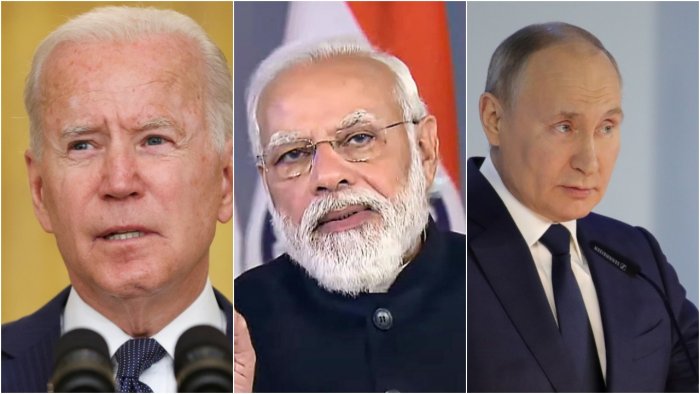
Moscow’s decision to recognise the Lugansk and Donetsk People’s Republics and then launch a ‘special military operation’ in Ukraine has created a tricky balancing act for New Delhi. India immediately responded in a restrained and neutral manner. On one hand India is worry about the safety of its thousands of nationals, mostly students inside Ukraine and the otherhand security dependence on Russia.
Besides generating a humanitarian crisis and sending shockwaves around the world, Russian President Vladimir Putin’s actions in Ukraine have also put the foreign policies of the countries in the spotlight.
Though India is taking every care of not to hurt both the countries, locked up in the intensified war, practically is seen as a supporter of Russia on the international forums like United Nation’s agencies. India has abstained five times so far from condemning Russia’s actions at the United Nations and only reiterated a “commitment to the principles of the UN Charter, to international law and respect for sovereignty and territorial integrity of all states”.
Several hours after Russian military action was underway, Prime Minister Narendra Modi held a phone call with Russian President Putin. He was the first head of a nation, who directly spoke with Putin, after the start of the war. Modi urged that all violence should be ceased immediately and reiterated India’s emphasis on diplomacy and ‘honest and sincere dialogue’ between Russia and NATO.
Later, Modi also held a telephone conversation with Ukraine’s President Volodymyr Zelenskyy. The conversation came four days after Ukraine’s Prime Minister Denys Shmyhal had reached out to PM Modi and hours after India’s abstention during a U.N. Security Council resolution on the unfolding conflict.
“President Zelenskyy briefed the Prime Minister in detail about the ongoing conflict situation in Ukraine. The Prime Minister expressed his deep anguish about the loss of life and property due to the ongoing conflict. He reiterated his call for an immediate cessation of violence and a return to dialogue, and expressed India’s willingness to contribute in any way towards peace efforts,” said a statement from the Prime Minister’s Office here.
India’s response
Amid the ongoing Ukraine-Russia crisis, Union Minister of State for External Affairs Rajkumar Ranjan Singh said that India’s stand is neutral and the country hopes for a peaceful solution to the conflict. “Our stand is neutral and we hope for a peaceful solution,” he added.
While addressing BJP workers at party’s headquarters in New Delhi, following assembly elections results on March 10, 2020, Pm Modi referring to Ukraine crisis explained India’s position.
“India has a connection with countries involved in the war – economically, security-wise, education-wise and politically as well. India’s several needs are connected to these countries,” said PM Modi while giving a victory speech to his party workers in Bharatiya Janta Party (BJP) headquarters in New Delhi.he said.
The government has given clear indication in all respects stating that for now stick to a path of strategic ambivalence on the Ukraine crisis. This is a pragmatic choice, one that reflects the complexities of a realist world and Delhi’s own positions on territorial integrity and sovereignty, its own concerns about its unresolved borders, its difficult relationship with its two northern neighbours.
Ukraine, in fact, sought India’s support in its fight against the Russian forces, soon after their invasion into the country. In an emotional appeal to Prime Minister Narendra Modi, Ukrainian ambassador Dr Igor Polikha told news agency ANI,”I don’t know how many world leaders Putin may listen to but the status of Modi ji makes me hopeful. In case of his strong voice, Putin at least should think over. We are expecting for much more favourable attitude of the Indian government.”
India’s strategic relations with Russia
Russia remains India’s biggest and time-tested supplier of military hardware. At the height of the crisis with China in Ladakh, it was to Moscow that Defence Minister Rajnath Singh travelled to ensure that there would be no cut-back in military supplies.
And since then, Russia has boosted India’s defence capability against China with the S-400 air defence system. Moscow is also a reliable ally in the UN Security Council. India-Russia ties have ensured that Delhi has not been entirely left out of the conversation on Afghanistan, and in Central Asia, while also providing some leverage with the US.
Moreover, India does not have many significant security interests in Europe, which helps explain its relative aloofness to the Ukraine crisis. But Delhi does have some stakes in Ukraine.
For instance, the Indian Space Research Organisation’s semi cryogenic engine is being developed based on Ukrainian supplied RD-810 designs and many Indian navy warships depend on Ukrainian gas turbines, including those under construction at Russian shipyards. So India has a national security stake in not alienating Ukraine.
Another reason for India’s repeated calls for the cessation of violence, de-escalation and resolving the situation through diplomacy is high energy prices, which may negatively affect India’s stressed economy.
US, Europe are vital partners
At the same time, India also may not distance itself from the US, the European Union, and UK, who are all vital partners, and India’s relations with each of them, and the Western world in general, go far beyond the sum of their parts.
Moreover, in the UNSC, India has counted on France’s unstinted backing on many issues. It has relied on western support as it deals with an aggressive China on the Line of Actual Control.
In recent years, India has been bolstering ties with the EU to ward off threats from China. At the recent Indo-Pacific Forum, EU foreign ministers and Indian Foreign Minister Subrahmanyam Jaishankar agreed to deepen security relations by coordinating maritime presence in the Indian Ocean and enhancing cyber security
Prime Minister Modi’s appeal to President Putin night for a “cessation of violence” and for all sides to return to the dialogue table was certainly a notch up from India’s earlier explicitly neutral stance, and carried a hint of the compulsions to get off the fence, though still largely maintaining a balance.
But, India’s balancing act of appeasing both Russia and the West in the Ukraine crisis has not taken well by the European Union well. UK and several other countries appealed to India to take a `principled stand’ on the crisis.
According to Indian media reports, EU envoys together with Ukraine’s envoy to New Delhi met senior Indian foreign ministry officials before a landmark vote in the UN General Assembly and urged India to adopt a stronger position on the conflict.
French President Emmanuel Macron also held consultations with Modi on the matter. France currently holds the presidency of the Council of the EU and a proactive Macron has been holding regular talks with EU leaders and global leaders to de-escalate the crisis.
.Garima Mohan, fellow at the Asia Program of the German Marshall Fund of the United States, says while Europe-India ties have made a lot of progress in recent years, India might have to re-evaluate its stance on the Russian invasion of Ukraine.
“European officials working with India are disappointed but certainly understand its position. The official line is everything is business-as-usual with India. But for political actors and European publics not familiar with Indian foreign policy, it will be a hard sell,” she told Al Jazeera.
“It is important to note that India’s position is evolving and as the crisis accelerates, India will have to re-evaluate its response,” she added.
Indian foreign policy at test
Since Independence, Indian foreign policy mostly preaching principles, more than India’s interests, unlike our neighbor Pakistan, which has been succeeded in cultivating strategic relations with both USA and China for several decades. It acted like a `mediator’ in first phase between USA and China in normalizing their relations and later between USA and Taliban in Afghanistan crisis.
Due to its crucial role on the issues of China and Afghanistan, both USA and West remaining `patience’ with it, though it is evident of remaining as a hot-bed for providing shelter and also resources to dreaded global terrorist groups.
Even India remained as a `strategic partner’ to USA, hardly it has taken us into `confidence’ on several critical matters like dealing with Taliban. During `cold war’ period, though India promoted `policy of non-alignment’, India was seen as a close ally of USSR, keeping distance to USA.
Since Vajapayee regime, India started to reach out USA by continuing its `strategic’ association with Russia. It reached to a formal binding factor during Dr Manmohan Singh regime through Indo-USA Nuclear deal. Later, it cultivated into `Strategic Partnership’ during Narendra Modi’s era.
Surprisingly, except Left, all the mainstream political parties in India are also maintaining restrained `silence’ on Ukraine crisis. Only a couple of individual voices are heard seeking India to take a `principled position’.
Former union minister P Chidambaram tweeted: “The Government of India should stop its verbal balancing act and sternly demand that Russia stop immediately the bombing of key cities in Ukraine.” Former union minister Shashi Tharoor also stressed on the need to take a `principled position’, if India wish to play decisive role in global arena.
