



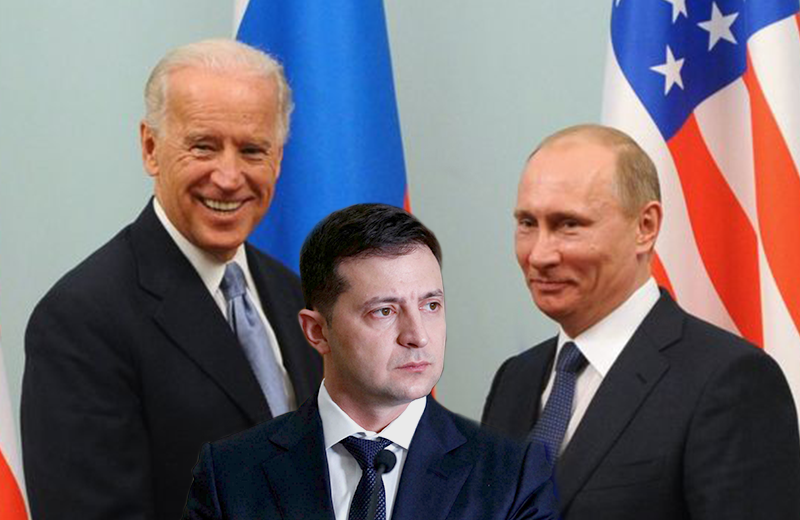
The U.S.media have been shrill in declaring that Russia, having positioned tens of thousands of Russian troops on the border, may be about to invade Ukraine. U.S. State Department spokesmen have been threatening Russia with punishing economic sanctions if there were an invasion.
TV viewers are shown satellite images supposedly showing Russian troop concentrations on the Ukraine border, accompanied by unflattering photos of a scowling Vladimir Putin, depicted as the evil source of the newU.S.-Russia tensions.
The cold war with Russia, festering since 2014 and the U.S.-backed coup in Ukraine, may be potentially even more menacing than the new cold war with China.
If the armed standoff between the Ukrainian military and the Russian-supported separatist forces in eastern Ukraine becomes — by miscalculation or design — a conventional war between Russia and NATO, it could escalate into nuclear war.
This is the second Ukraine crisis in a year. In March, the U.S. announced $125 million in military aid to Ukraine, including armed coastal patrol boats and radar equipment, with another $150 million package in June. This included radar, communications, and electronic warfare equipment for the Ukrainian Air Force.
This latest package appears to include deploying U.S. training personnel to Ukrainian air bases. According to published reports, Turkey, another NATO state, is supplying Ukraine with the same drones it provided to Azerbaijan for its war with Armenia over the disputed territory of Nagorno-Karabakh in 2020.
In April 2021, the anti-Russian government of Ukraine threatened an offensive against breakaway Russian-speaking eastern regions of Donetsk and Luhansk, and Russia assembled thousands of troops along Ukraine’s eastern border. Since April 2021, NATO has been building up military pressure on Russia in the region.
Summer 2021 saw 30,000 troops take part in Operation Defender Europe 2021, a mammoth set of U.S.-led military exercises from the Baltic to the Black Sea, while last month the U.S. staged simulation bombing raids within 12 miles of Russian airspace.
According to NATO itself, its warplanes confronted Russian aircraft 290 times in 2021, most of the time along Russia’s western borders. It means nearly 80 percent of NATO’s 370 flight missions this year involved confrontations with the Russian air force.
On Dec 7, 2021, Undersecretary of State for Political Affairs Victoria Nuland testified to the Senate Foreign Relations Committee that the U.S. government has given $2.4 billion to Ukraine since 2014 “in security assistance,” which included $450 million that was given in 2021 alone.
She reportedly tried to reassure Moscow that the U.S. and NATO were still committed to the 2014-2015 Minsk Accords, which included a ban on offensive military operations and a promise of greater autonomy for Donetsk and Luhansk within Ukraine.
But her assurances were undone by Defense Secretary Lloyd Austin when he met with Ukraine’s President Zelensky in Kiev in October, reiterating U.S. support for Ukraine’s future membership in NATO, promising further military support and blaming Russia for “perpetuating the war in Eastern Ukraine.”
The Russian Proposals
Russian diplomats are warning that current U.S./NATO policy in Ukraine risks crossing Russia’s security “red lines” and facts on the ground support their concerns:
● Consider the fact that every U.S. and NATO promise to keep NATO away from Russian borders has been broken for thirty years.
● Consider the fact that since 1990, NATO — which ought not to exist since its antagonist, the Warsaw Pact, went out of existence in 1991 — has moved inexorably eastward. In 1990, with German reunification and the annexation of the GDR, all of Germany became part of NATO.
In 1999 the Czech Republic, Hungary, and Poland joined NATO. In 2004 Estonia, Latvia, Lithuania (all former Soviet Republics), Bulgaria, Romania, Slovakia, and Slovenia joined NATO. In 2009 Albania and Croatia joined NATO. In 2017 Montenegro joined NATO. In 2020 North Macedonia joined NATO.
● The incorporation of Ukraine into NATO would move NATO weapons and troops even closer to the heartland of Russia. This is to say nothing of the fact that, within living memory, the Russian people suffered invasion from the West. In 1941-45 Hitler’s armies, 4 million strong, devastated the country in a genocidal war that took some 27 million lives.
In his year-end press conference on December 23rd, Mr. Putin stressed that “Further movement of NATO eastward is unacceptable. They are on the threshold of our house. Is it an excessive demand — no more attack weapons systems near our home? Is there something unusual about this?”
One need not be an unqualified admirer of the politics of Vladimir Putin to acknowledge that the Russian leader has legitimate security concerns.
In mid-December, Russia took a diplomatic initiative and presented a list of security proposals to the United States. According to the Wall Street Journal:
The proposals handed to the U.S. and published by Russia’s Foreign Ministry include a promise for each side to refrain from carrying out activities affecting each other’s security, preventing the North Atlantic Treaty Organization’s expansion further eastward to include Ukraine, and abandoning any NATO military activities in all of Eastern Europe, Transcaucasia and Central Asia.
“It is fundamentally important for us that the guarantees of Russian security are put on paper and [are] as legally binding as possible,” Russian Deputy Foreign Minister Sergei Ryabkov told reporters Friday. “There is no other option, since a characteristic feature of the current stage of relations between Russia and the collective West is a complete lack of trust.”
The proposals also call for no deployment of additional NATO troops and weapons outside the countries in which they were stationed before any Eastern bloc nations joined the alliance in May 1997, unless both sides agree.
Each side should refrain from deploying intermediate and shorter-range missiles where they can hit the territory of the other side, and not use the territory of another state to carry out an armed attack against the other.
Among Russian proposals were also an agreement for both sides to regularly exchange information about military exercises and refrain from conducting military exercises and other actions with more than a brigade in the agreed border zone.
So are the Minsk II Accords (2015) agreed to by France, Germany, Russia and Ukraine and endorsed unanimously by the UN Security Council, including the United States. The Accords provided for demilitarization of eastern Ukraine, restoration of Ukrainian sovereignty over the eastern regions, and full autonomy for the Donbas region. Despite occasional lip service, they have been largely ignored by the U.S. and NATO.
US- Russia meet on Jan 10
It is welcome that the U.S. has agreed to talks in Geneva on January 10, 2022 on the new Russian proposals for legally binding security guarantees. It is also welcome that on December 30, 2021 President Biden had another phone conversation with President Putin.
Meanwhile, US President Joe Biden and his Russian counterpart Vladimir Putin emphasised the need for diplomatic solutions ahead of their latest phone call Thursday aimed at defusing tensions surrounding the Ukraine conflict.
The call comes after Moscow earlier this month presented Western capitals with sweeping security demands, saying NATO must not admit new members and seeking to bar the United States from opening new bases in ex-Soviet countries.
US and Russian presidents are not expected to attend the Geneva meeting personally and they will appoint experts and officials to negotiate for their countries,
The Senior Administration Official indicated that upcoming talks are focused upon “getting to a diplomatic end-game” and getting to meaningful understandings between the US and the Russian Federation, between NATO and the Russian Federation, and between Ukraine and the Russian Federation with an aim to seeing de-escalation and alleviation of the situation rather than an exacerbation of it.
But the U.S. has already rejected several of the Russian security demands, including one that both countries commit to not stationing nuclear weapons outside of their own territory. And there are signs that the Russian side is already skeptical of U.S. good faith. Russian Foreign Minister Sergei Lavrov has stated, “It is important that our proposals aren’t wound up in endless discussions, which the West is famous for.”
Despite these diplomatic efforts, powerful institutional and economic forces in the U.S. — the military industrial complex, Lockheed-Martin, Boeing, Raytheon Technologies, General Dynamics, Northrop Grumman, and others — are eager for a new cold war with Russia, which would provide them with boundless opportunities for profitable arms contracts.
