



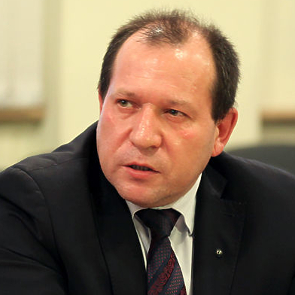
Unknown individuals placed offensive posters on the door of the apartment where Russian human rights defender Igor Kalyapin is registered, in Nizhny Novgorod of Russia on January 29. One of the posters displayed “Igor Kalyapin defends terrorists! Shame on foreign agent!”, while the other one stated “Igor Kalaypin is a foreign agent! Sold the Motherland for German and American grants!”. He reported that the person inhabiting the apartment is his 84-year-old mother.
Igor Kalyapin is a human rights defender, founder and former chairperson of the Committee Against Torture (CAT). He is also the founder and President of the Joint Mobile Group (JMG), which several human rights organizations established in November 2009 following the murder of woman human rights defender Natalia Estemirova in Chechnya.
The JMG received the Front Line Defenders (FLD) Award in April 2011 for their work in investigating torture and disappearances in Chechnya and he was also the 2013 recipient of the Martin Ennals Award. Igor Kalyapin is also a member of Russia’s Presidential Council for Civil Society and Human Rights.
The CAT’s public campaign calling for the immediate release of Zarema Musaeva, the mother of human rights defender Abubakar Yangulbayev, caused outrage among Chechen pro-governmental media outlets. The smear campaign against Igor Kalyapin is related to CAT’s intensive work following the recent abduction of Zarema Musaeva by Chechen law enforcement officers.
On January 20, Chechen law enforcement abducted the mother Yangulbayev, Zarema Musaeva, and attacked human rights defenders and lawyers Sergey Babinets and Oleg Khabibrakhmanov and woman human rights attorney Natalia Dobronravova. On January 23, the Head of the Chechen Republic, Ramzan Kadyrov, called Igor Kalyapin and Novaya Gazeta’s journalist and woman human rights defender Elena Milashina “terrorists” and stated that “terrorist should be eradicated.”
This is not the first time that the “foreign agent” rhetoric is being used to intimidate human rights defenders from the CAT. In 2012, when the Russian government first introduced the “foreign agent” law, human rights defenders from the CAT were already targeted with a smear campaign based on the “foreign agent” rhetoric.
In 2012, a group of unknown individuals targeted the CAT’s deputy Chairperson, Olga Sadovakaya, inscribing “foreign agent” on fences next to her house. Numerous human rights organizations and defenders in Russia were targeted with similar smear attacks during that period.
FAT reiterates its concerns about Russia’s “foreign agents” law and condemns the intimidation and targeting of human rights defenders and considers it an attempt to threaten, silence, and stop their crucial work protecting human rights in the Chechen Republic and other republics of the North Caucasus. fLD is gravely concerned by the continued intimidation campaign against human rights defenders from the Committee against Torture working on the case of Zarema Musaeva’s.
FLD urged Russian authorities to carry out an immediate, thorough and impartial investigation into the intimidation campaign against the human rights defender Igor Kalyapin and his family, with a view to publishing the results and bringing those responsible to justice in accordance with international standards;
It also asked to carry out an immediate, thorough and impartial investigation into the abduction of Zarema Musaeva, mother of human rights defender Abubakar Yangulbayev. with a view to ensuring her protection, publishing the results and bringing those responsible to justice inaccordance with international standards;
FLD want to cease the practice of using the word “terrorism” against civil society activists, human rights defenders and journalists in reprisal for their legitimate human rights work; It asked to abolishthe discriminatory “foreign agents” law; and
FLD want to guarantee in all circumstances that all human rights defenders in Russia, including in Russia’s Republic of Chechnya, are able to carry out their human rights activities without fear of reprisals and free of all restrictions, in line with Russia’s international human rights obligations and commitments.
