



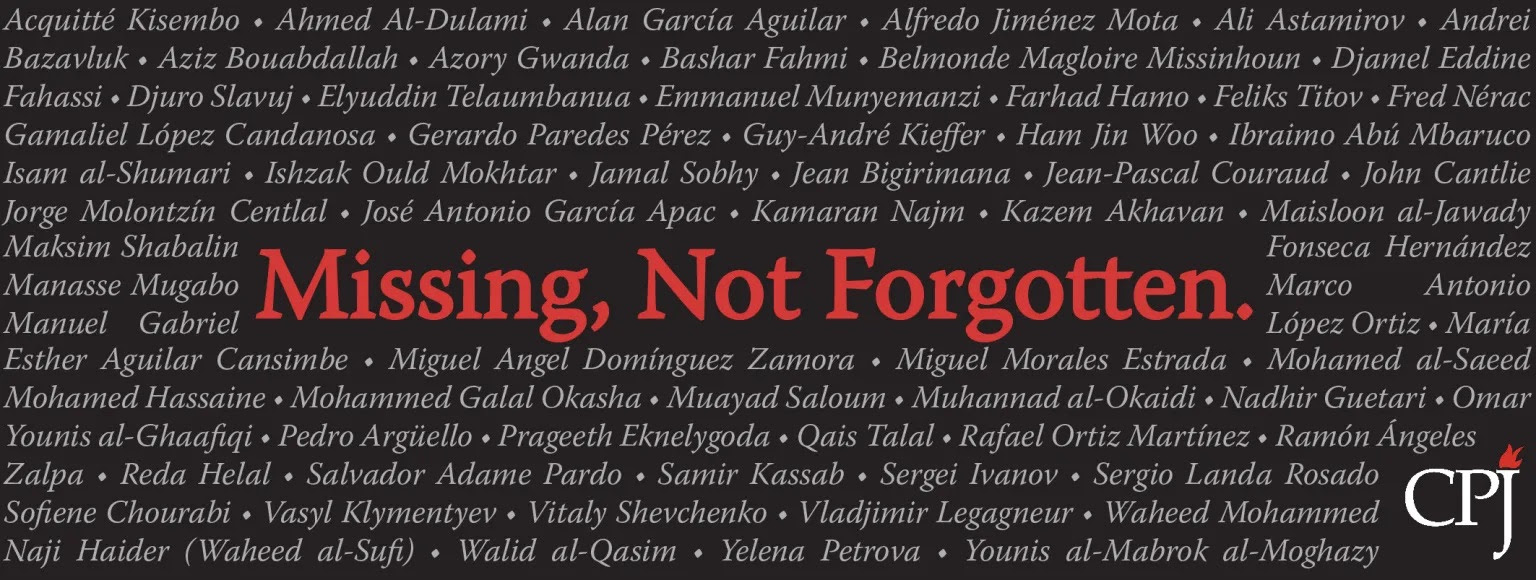
August 30 marked the International Day of Victims of Enforced Disappearances, with Committee to Protect Journalists (CPJ) documenting at least 65 journalists missing globally. Official indifference and failure to investigate these disappearances cast a chill on other reporters and devastate the journalists’ families, who are often left in the dark with little to no support.
Mexican journalist Jorge Molontz Centlal vanished in 2021 in Mexico, the country with the highest number of missing journalists globally—16. Nearly one in four documented missing journalists disappeared in Iraq and Syria between 2012 and 2014.
Some have been missing longer: Isam al-Shumari, an Iraqi camera operator for Sudost Media, went missing in Fallujah, Iraq, on August 15, 2004. It was the same day his friend and colleague, camera operator Mohamoud Abbas, was killed while on assignment for German station ZDF.
Journalist Azory Gwanda went missing in Tanzania in November 2017. Nearly six years after his disappearance, Tanzania’s government has failed to account for his whereabouts.
CPJ said that it will continue to fight and advocate for all missing journalists globally—they are missing but not forgotten. CPJ calls on governments to provide accountability and investigations into their disappearances.
Worrying situation in Niger
Meanwhile, the situation of the media is worrying in Niger, one month after the military coup there. Mobilised by Reporters Without Borders (RSF), African media professionals have issued a joint appeal to Niger’s military junta, the National Council for the Safeguard of the Homeland (CNSP), to respect press freedom.
Since 26 July, the date of the coup, local and international journalists have been physically attacked and harassed online and media have been suspended. Media freedom and pluralism are being directly targeted. The right to inform and be informed must not be called into question in Niger at a time of political turmoil.
Journalists and press freedom organisations across Africa, from Niamey to Djibouti and from N’Djamena to Antananarivo, came together to call on Niger’s junta to respect the fundamental right to reliable and pluralistic media reporting, and to not obstruct journalists’ work.
