



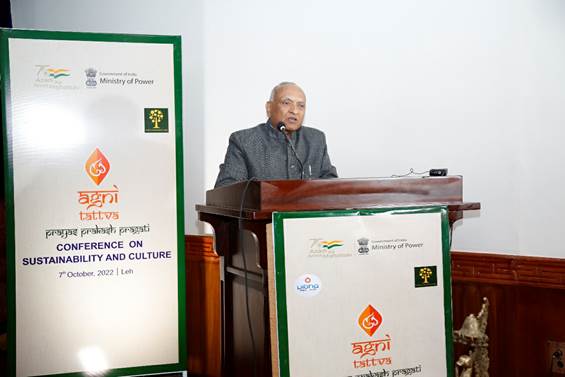
R K Mathur, Lieutenant Governor of Ladakh, said that Ladakh always had a sustainable lifestyle, however, increased modernisation is leading to an imbalance in the ecosystem of the region, and this not only adversely impacts the region but could also alter the monsoon cycle of the entire country since it is inter-linked with the Himalayan ecosystem.
He was addressing the first conference of the Agni campaign was organised in Leh, on the theme of ‘Sustainability and Culture’. Power Foundation of India in association with Vijnana Bharati (VIBHA) is currently running a campaign to create awarenesson Agni Tattva under LiFE – Lifestyle for environment.
He further added that the UT administration of Ladakh has laid out a clear roadmap to reverse this imbalance and move toward sustainable development. He emphasised several key areas.
Ladakh has immense solar energy potential, which should be harnessed. Ladakh should work towards generating systems to provide power to remote areas. The focus is to provide decentralized renewable solar power across Ladakh thereby reducing grid dependency. This is in line with the Prime Minister’s vision of a Carbon Neutral Ladakh.
Geothermal energy is another focus area that holds immense potential in the Ladakh region. Unlike other renewable energy sources, which are intermittent in nature, it is available throughout the day and the year and should be suitably harnessed.
Green Hydrogen is another option in Ladakh, as the region has plenty of solar energy. It also has water. The Hydrogen harnessed from this could be used to substitute petrol and diesel and the oxygen could be used in hospitals and by tourists.
Jamyang Tsering Namgyal, MP of Ladakh emphasized on an interdependent world. He said that Indian philosophy views the world as one and everything in it as one, but in the development model so far, the oneness has been lost.
