



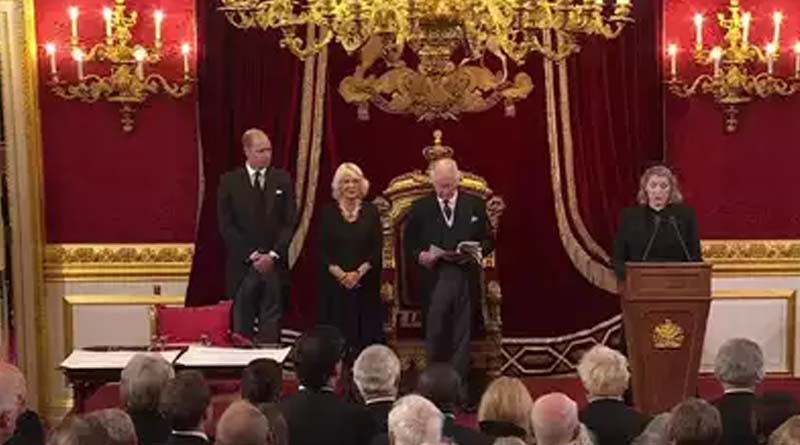
King Charles III was on Saturday proclaimed Britain’s new monarch in a historic ceremony of the Accession Council that was televised for the first time in history. ‘God save the King’ were the words with which those gathered reaffirmed the proclamation made by the clerk of the council.
The throne had passed to the 73-year-old former Prince of Wales following the death of his mother, Queen Elizabeth II, on Thursday and Saturday’s ceremony marked his formal declaration and oath taking at St. James’s Palace in London.
A Principal Proclamation was read in public for the first time by the Garter King of Arms from the balcony overlooking Friary Court at St James’s Palace, accompanied by a 41-gun salute fired by The King’s Troop Royal Horse Artillery at Hyde Park in London.
King Charles was joined by his wife, Queen Consort Camilla, and his son and heir Prince William the new Prince of Wales. The King had travelled back from Balmoral Castle in Scotland on Friday, where the Queen’s health deteriorated and she breathed her last.
Flags lowered atop the palace in mourning for the late Queen were brought back up to full mast after the Accession Council proclamation, which followed a wave of further proclamations across the UK to go into Sunday when flags will return to half-mast in a state of mourning for the Queen.
“As the Queen herself did with such unswerving devotion, I too now solemnly pledge myself, throughout the remaining time God grants me, to uphold the constitutional principles at the heart of our nation,” Charles said in his first televised address as King on Friday evening.
“And to my darling Mama, as you begin your last great journey to join my dear late Papa, I want simply to say this: thank you. Thank you for your love and devotion to our family and to the family of nations you have served so diligently all these years. May flights of Angels sing thee to thy rest’,” he said.
The Privy Council, which includes politicians, senior members of the clergy and Supreme Court justices, first gathered without the King to proclaim the new monarch and arrange business relating to the proclamation.
Following the proclamation, King Charles III held his first Privy Council meeting and made his personal declaration to “assume the duties and responsibilities of sovereignty” and follow in the footsteps of his late mother.
