



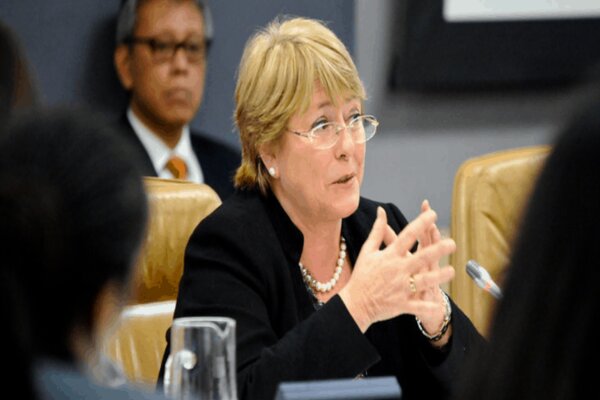
UN High Commissioner for Human Rights Michelle Bachelet ended her 6-day visit to China on Friday, May 28th. Bachelet visited the Xinjiang cities of Urumqi and Kashgar, but no photos or further details of her itinerary were released during the trip.
The envoy said she had visited a prison in Kashgar, where she saw prisoners and an internal court of appeal, and described her access as “pretty open, pretty transparent.”
The High Commissioner’s agenda was surrounded by controversy, and after she gave her statement on Saturday, activists gave their resounding assessment: the visit has been a missed opportunity, a failure, and an error.
Many claim that the UN participated in a Chinese propaganda exercise, while others go further and directly ask the UN High Commissioner to resign for not responding to the genocide that China is carrying out against the Uyghur minorities.
Facing criticism that she did not hold Beijing accountable for its alleged human rights violations, Bachelet noted in her statement that her visit was “not an investigation,” but insisted that she spoke with “candor” during her official meetings with China’s president and top officials of the regime.
She also said the visit will pave the way for more regular interaction to support China in meeting its obligations under international human rights law:
“The visit was an opportunity to hold direct discussions – with China’s most senior leaders – on human rights, to listen to each other, raise concerns, explore and pave the way for more regular, meaningful interactions in the future, with a view to supporting China in fulfilling its obligations under international human rights law.”
The Chinese ruling party continues to vehemently deny all allegations of human rights violations and genocide in Xinjiang.
Moreover, Bachelet mentioned that the authorities of the Chinese region had assured her that the network of “vocational training centers” — places we have already described as forced re-education camps — had been “dismantled.”
Human rights leaders who have been working for years to raise awareness on this issue and to influence the G7 countries to ban products produced in the Xinjiang region due to the systematic forced labor scheme promoted by Beijing have given their perspectives in statements and in the press.
Sophie Richardson, China’s Human Rights Watch Director, told Bloomberg TV that Bachelet’s visit seemed to be aimed at “making nice with the Chinese government” rather than holding it accountable for some of the worst human rights violations it has committed under international law. She urged Bachelet to urgently publish a report on the crimes committed by the Chinese government against humanity, the Uyghurs, and other Muslim communities.
