
Tattva NewsTattva News
  • Telegu states
  • Regional
  • National
  • International
  • Economy
  • Others
  • Special Stories
  • Opinion
Weather Report
Facebook Twitter Instagram
Trending
  • Dr Bhagwat slams regulatory rigidity in education
  • Indian EV market to touch Rs. 20 lakh crore by 2030
  • Pragjyotishpur LitFest ’24 concludes with a high note
  •  Former Haryana CM, INLD chief Om Prakash Chautala passes away
  • Parliament adjourns sine die amid protests by Opposition and treasury benches
  • Opposition notice for no-confidence against Dhankhar rajected
  • PM Modi lists out ‘sins’ of Congress towards Ambedkar
  • Globally a record number of journalists killed in 2024: India loses 4 scribes
Facebook Twitter Instagram Pinterest
Thursday, February 19
Click for the latest Hyderabad weather forecast.
Telugu
Tattva NewsTattva News
  • Telegu states
  • Regional
  • National
  • International
  • Economy
  • Others
  • Special Stories
  • Opinion
Tattva NewsTattva News
Telugu
Home » Scientists develop energy-efficient hydrogen production by urea electrolysis
Others

Scientists develop energy-efficient hydrogen production by urea electrolysis

Editor's Desk, Tattva NewsBy Editor's Desk, Tattva NewsMarch 10, 2022Updated:March 10, 2022No Comments3 Mins Read
Facebook Twitter Pinterest LinkedIn Tumblr Email
Share
Facebook Twitter LinkedIn Pinterest Email

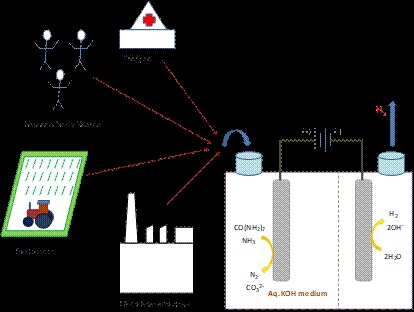
Indian Scientists have designed an electrocatalyst system for energy-efficient hydrogen production with the help of electrolysis of urea. The urea electrolysis is helpful towards urea-based waste treatment with low-cost hydrogen production. This can be utilized for energy production towards our country’s benefits.

The energy requirement for production of hydrogen through water electrolysis can be reduced by 70 % through urea electrolysis. The energy-intensive counterpart of water splitting, oxygen evolution, can be replaced with urea oxidation in urea electrolysis.

The low-cost, earth-abundant Ni-based catalysts are widely applied for this process. The main challenge associated with urea oxidation is retaining the prolonged activity of the catalyst as the strong adsorption of the reactive intermediate (COx) on the active site, referred to as catalyst poisoning, causes activity loss.

Towards this end, Mr. Alex C, Mr. Gaurav Shukla, Mr. Muhammed Safeer N. K., and Dr. Neena S John from the Centre for Nano and Soft Matter Sciences (CeNS), an autonomous institute of the Department of Science & Technology, Govt. of India have developed this Nickel oxide (NiOx) based system for producing hydrogen from electro-oxidation of urea.

In the series of research works published in the journals ‘Electrochimica Acta’and ‘Journal of Materials Chemistry A, the scientists have explored electrocatalysts and shown that surface defective NiO and Ni2O3 systems having more Ni3+ ions are more efficient electrocatalysts than conventional NiO. They haveused high-energy electron beams to produce surface defective unsaturated Ni sites in NiO (e-NiO).

The study reveals that e-NiO prefers direct mechanism of urea electro-oxidation due to strong adsorption of urea molecule, whereas NiO favors indirect mechanism with low activity. Further, the prominent electrocatalyst poison COx could be removed by adjusting the molar ratio of KOH and Urea with improved kinetics.

The researchers, Alex and Gaurav, are of the opinion that the e-beam treatment is an effective way to produce a large number of coordinatively unsaturated active sites on electrocatalysts. It was observed that these generated sites effectively adsorb urea and favors direct urea electro-oxidation mechanism (UOR).

The researcher, Safeer, continued the studies on another Ni3+ oxide system (Ni2O3), revealing that active species Ni3+O(OH) on Ni2O3 possess high COx tolerance than NiO. The active species of high valent Ni oxide system has a profound effect on catalyst activity.

The urea electrolysis is helpful towards urea-based waste treatment with low-cost hydrogen production. India is one of the top countries by urea production, and it produced 244.55 LMT of urea during 2019-20. The nitrogenous fertilizer industries generate a high concentration of ammonia and urea as effluents. This can be utilized for energy production towards our country’s benefits.

energy-efficiant hydrogen UOR urea electrolysis
Share. Facebook Twitter Pinterest LinkedIn Tumblr Email
Editor's Desk, Tattva News

Related Posts

Protests erupt in Kolkata after CBI fails to frame charges against ex-RG Kar principal

December 15, 2024

India leads globally in AI upskilling

December 6, 2024

India successfully tests nuclear-capable 3,500 km range ballistic missile 

November 28, 2024

FIR against SP MP Barq, MLA Mehmood’s son

November 26, 2024

Centre dispatches 90 additional security force companies to Manipur

November 23, 2024

Draft report on Waqf Amendment Bill ready

November 22, 2024

Leave A Reply Cancel Reply

FOLLOW US
  • Facebook
  • Twitter
  • Instagram
  • YouTube
  • LinkedIn
REGIONAL

‘Samatar Chandere Jivanar Joigaan’ to pay homage to Ambedkar

December 6, 2024

PPFA offers thanks to Delhi, Dispur for classical recognition to Asomiya

October 12, 2024

Yogi slams Congress prince heading to become anti-India separatist group leader

September 12, 2024

Rajasthan CM  gets threat call from Dausa jail

July 29, 2024
NATIONAL

Dr Bhagwat slams regulatory rigidity in education

December 21, 2024

 Former Haryana CM, INLD chief Om Prakash Chautala passes away

December 20, 2024

Parliament adjourns sine die amid protests by Opposition and treasury benches

December 20, 2024

Opposition notice for no-confidence against Dhankhar rajected

December 20, 2024
Tattva News
Facebook Twitter Instagram Pinterest LinkedIn
  • Telegu State
  • Regional
  • National
  • International
  • Economy
  • Others
  • Special Stories
  • Opinion
  • Contact Us
© 2026 Tattva Talks Designed by Dhanush Infotech .

Type above and press Enter to search. Press Esc to cancel.