



Union Minister, Jal Shakti Gajendra Singh Shekhawat said that Jal Jeevan Mission is the world’s largest drinking water project. When the programme was launched, we were at 17% and today we have provided nearly 6 Crore tap water connections in the last 2½ years and stand at 47%, despite challenges of Covid-19.
It is important to plan, issue work order and ensure work starts especially where multi-village schemes are proposed as it will take longer time to complete. We cannot miss the target deadlines set for 100% tap water coverage across all States/ UTs, he added.
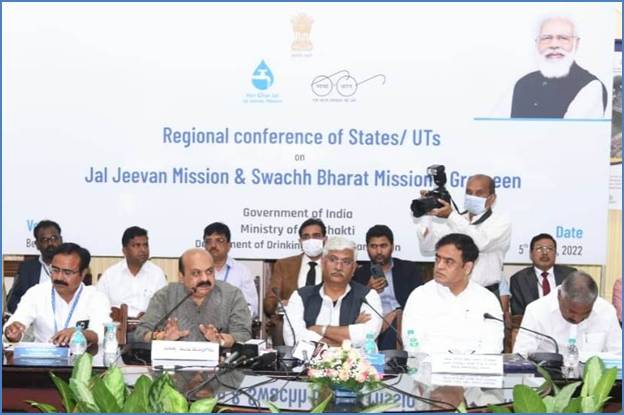
He chaired a Regional Conference of Ministers from 6 States and 2 Union Territories at Vidhana Soudha, Bengaluru to review the progress made under Jal Jeevan Mission and Swachh Bharat Mission-Grameen. The 6 participating States and 2 UTs were Andhra Pradesh, Karnataka, Kerala, Madhya Pradesh, Tamil Nadu, Telangana, Puducherry and Lakshadweep.
He asserted that the Government of India accords top priority to Jal Jeevan Mission (JJM) and Swachh Bharat Mission (Grameen) which is evident from the funds allocated by the Centre to the States/ UTs for the implementation of these two flagship programmes.
Funds to the tune of Rs. 20,487.58 Crore is allocated under JJM and an amount of Rs 1,355.13 Crore is allocated under SBM(G) for the participating 6 States and UT of Puducherry in the current financial year and under 15th Finance Commission, Rs 7,498 Crore have been allocated as tied-grant to 6 participating States.
Expressing his concern during the inaugural address said, “We need to bridge the gap between the rural and urban. In line with the philosophy of Prime Minister Narendra Modi of ensuring ‘no one is left out’, we are marching ahead to achieve 100% tap water connectivity to all rural households of the country” he added.
Shekhawat further added that “JJM is not just a programme of laying water supply infrastructure, we need to ensure long term sustainability and functionality through water source strengthening, grey water management, community participation, empowerment, etc. so that water is available for the next 30 years as per the design of the water supply scheme”.
The Union Minister also said, “the Ministry is committed to provide drinking water of prescribed quality to every rural household. It has come to our notice that there are 86 Fluoride affected habitations in Andhra Pradesh and 52 in Madhya Pradesh which deserve immediate remedial action. Similarly, there is information that in eastern districts of Karnataka water contamination is reported due to Uranium”.
The Union Jal Shakti Minister congratulated Telangana and Puducherry on providing tap water connection in all its rural households. He hoped that Madhya Pradesh will work with ‘speed and scale’ to ensure that all its rural homes gets access to tap water connection by 2023 followed by Karnataka, Kerala, Andhra Pradesh and Tamil Nadu in 2024.
The Union Minister further said, all support will be provided to Lakshadweep by Jal Jeevan Mission to plan and achieve ‘Har Ghar Jal’ as per the national deadline of 2024.
Basavaraj Bommai, Chief Minister of Karnataka said that Prime Minister Narendra Modi is the first leader to take the problem of water head-on and announced ‘Jal Jeevan Mission’ in August, 2019. He assured that his State will work with ‘speed and scale’ to achieve the target set by the Prime Minister to provide every rural household with clear tap water by 2024.
Peddi Reddy Rama Chandra Reddy, Panchayati Raj & Rural Development Minister from Andhra Pradesh, Brijendra Singh Yadav, Minister for State for Public Health Engineering Department, Madhya Pradesh, Dr. C. N. Ashwath Narayan, Minister IT, BT, S&T, Karnataka, Govind Karjol, Minister of Major and Medium Irrigation, Karnataka; and AK. Sai J Saravanan Kumar, Minister for Civil Supplies & Consumer Affairs, Puducherry attended the conference.
