



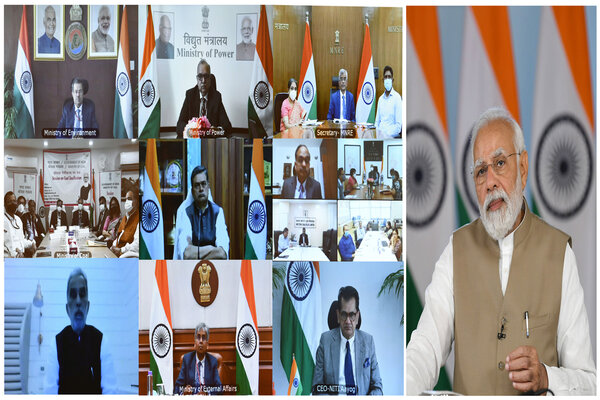
Prime Minister Narendra Modi said that ‘Energy for Sustainable Growth’ not only resonates with the Indian tradition but is a pathway to achieve future needs and aspirations. He said that sustainable growth is possible only through sustainable energy sources. The Prime Minister reiterated his commitment made at Glasgow to reach Net Zero by 2070.
Addressing a Webinar on “Energy for Sustainable Growth”, he also mentioned his vision of LIFE pertaining to an environmentally sustainable lifestyle. India is providing leadership in the global collaborations like International Solar Alliance.
He also talked of target of achieving 500 gigawatt non-fossil energy capacity and achieving 50 per cent of installed energy capacity through non-fossil energy by 2030. Referring to recently announced National Hydrogen Mission, the Prime Minister said India can become hub of green hydrogen given its inherent advantage in the form of abundant renewable energy power.
He emphasized that along with energy production, energy saving is equally important for sustainability. Stressing the need to prioritize energy efficient products, the Prime Minister gave the example of promotion of LED bulbs at large scale. He said that first the government brought down the cost of LED bulbs by promoting production and then 37 crore LED bulbs were distributed under Ujala scheme.
This has led to saving of forty eight thousand million Kilo Watt Hour electricity and saving of about 20 thousand crore rupees in the electricity bills of poor and middle class families. Furthermore, annual carbon emission saw a decline of 4 crore tonnes. He also talked about the future upsurge in the energy demand in India and underlined the criticality of transition towards renewable energy.
The webinar was part of the new practice of discussion and dialogue with the stakeholders before and after the budget. The objective is to brainstorm with experts from the public and private sectors, academia and industry and identify strategies on how best to move forward towards implementation of various issues under different sectors. The webinar had sessions on different themes of relevance and witnessed participation of government officials of various ministries and state governments and industry representatives.
