



A thousand years ago, Russia and Ukraine shared a legacy that both countries have complicated or shared. According to the Council on Foreign Relations, Ukraine was the breadbasket of Europe in the last century, one of the most populous and powerful republics in the former USSR and a significant agricultural import.
While Russia has watched over its neighbor to the West closely in the past, Ukrainians have experienced periods of protest and government corruption during their independence.
President Vladimir Putin claimed his goal was to protect people subjected to bullying and genocide and aim for the “demilitarisation and de-Nazification” of Ukraine. There has been no genocide in Ukraine: it is a vibrant democracy, led by a president who is Jewish.
“How could I be a Nazi?” said Volodymr Zelensky, who likened Russia’s onslaught to Nazi Germany’s invasion in World War Two.has frequently accused Ukraine of being taken over by extremists, ever since its pro-Russian president, Viktor Yanukovych, was ousted in 2014 after months of protests against his rule.
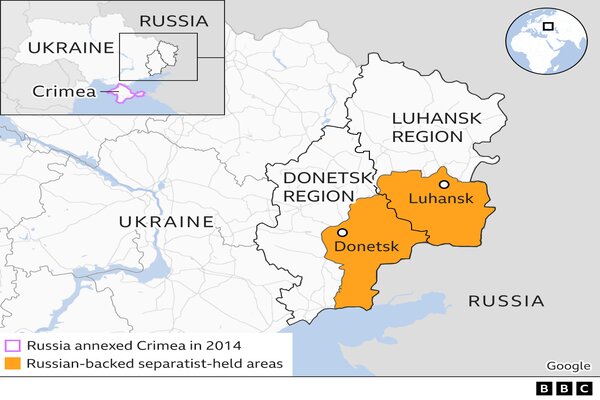
Russia then retaliated by seizing the southern region of Crimea and triggering a rebellion in the east, backing separatists who have fought Ukrainian forces in a war that has claimed 14,000 lives.
Late in 2021, Russia began deploying big numbers of troops close to Ukraine’s borders, while repeatedly denying it was going to attack. Then Mr Putin scrapped a 2015 peace deal for the east and recognised areas under rebel control as independent.
Russia has
long resisted Ukraine’s move towards the European Union and the West’s defensive military alliance, Nato. Announcing Russia’s invasion, he accused Nato of threatening “our historic future as a nation”.
This false narrative of a Ukraine seized by fascists in 2014 has been spun regularly on Kremlin-controlled TV. Mr Putin has spoken of bringing to court “those who committed numerous bloody crimes against civilians”.
What Russia’s plans are for Ukraine are unknown, but it faces stiff resistance from a deeply hostile population.
In January, the UK accused Moscow of plotting to install a pro-Moscow puppet to lead Ukraine’s government – a claim rejected at the time by Russia as nonsense. One unconfirmed intelligence report suggested Russia aimed to split the country in two.
Issues prompted Russia
- 1. Balance of Power. Ever since Ukraine split from the Soviet Union, both Russia and the West have vied for greater influence in the country in order to keep the balance of power in the region in their favour.
- 2. Buffer Zone for Western Countries. For the US and the EU, Ukraine is a crucial buffer beteen Russia and the West. As tensions with Russia rise, the US and the EU are increasingly determined to keep Ukraine away from Russian cont.
- 3. Russian Interest in Black Sea. The unique geography of the Black Sea region confers several geopolitical advantages to Russia. Firstly, it is an imp crossroads and start intersection for the entire region. Access to the Black Sea is vital for all littoral and neighboring states, and greatly enhances the projection of power into several adjacent regions. Secondly, the region is an imp transit corridor for goods and energy.
- 4. Protests in Ukraine. Euromaidan Movement – Euromaidan (European Square) was a wave of demonstrations and civil unrest in Ukraine, which began in November, 2013 with public protests in Maidan Nezalezhnosti (“Indep Square”) in Kyiv, Ukraine. The protests were sparked by the Ukrainian govt’s decision to suspend the signing of an association agreement with the EU, instead choosing closer ties to Russia and the Eurasian Econ Union.
- 5. Separatist Movement. The Donbass region (the Donetsk and Luhansk regions) of Eastern Ukraine has been facing a pro-Russian separatist mov since 2014. According to the Ukrainian govt, the mov is actively supported by the Russian govt and Russian paramilitaries make up between 15% to 80% of the separatists fighting against the Ukraine govt.
- 6. Invasion of Crimea. Russia seized Crimea from Ukraine in what was the first time a European country annexed territory from another country since World War-2. The annexation of Crimea from Ukraine followed a Russian mil intervention in Crimea that took place in the aftermath of the 2014 Ukrainian revolution and was part of wider unrest across Southern and Eastern Ukraine. The invasion and subsequent annexation of Crimea have given Russia a maritime upper hand in the region.
- 7. Ukrain’s NATO Membership. Ukraine has urged the North Atlantic Treaty Organization (NATO) to speed up his country’s membership in the alliance. Russia has declared such a move a “red line”, and worried about the consequences of the US-led military alliances expanding right up to its doorstep.
The Black Sea is bordered by Bulgaria, Georgia, Romania, Russia, Turkey and Ukraine. All these countries are NATO countries. Due to this faceoff betn NATO countries and Russia, the Balck sea is a region of strat importance and a potential maritime flashpoint.
