



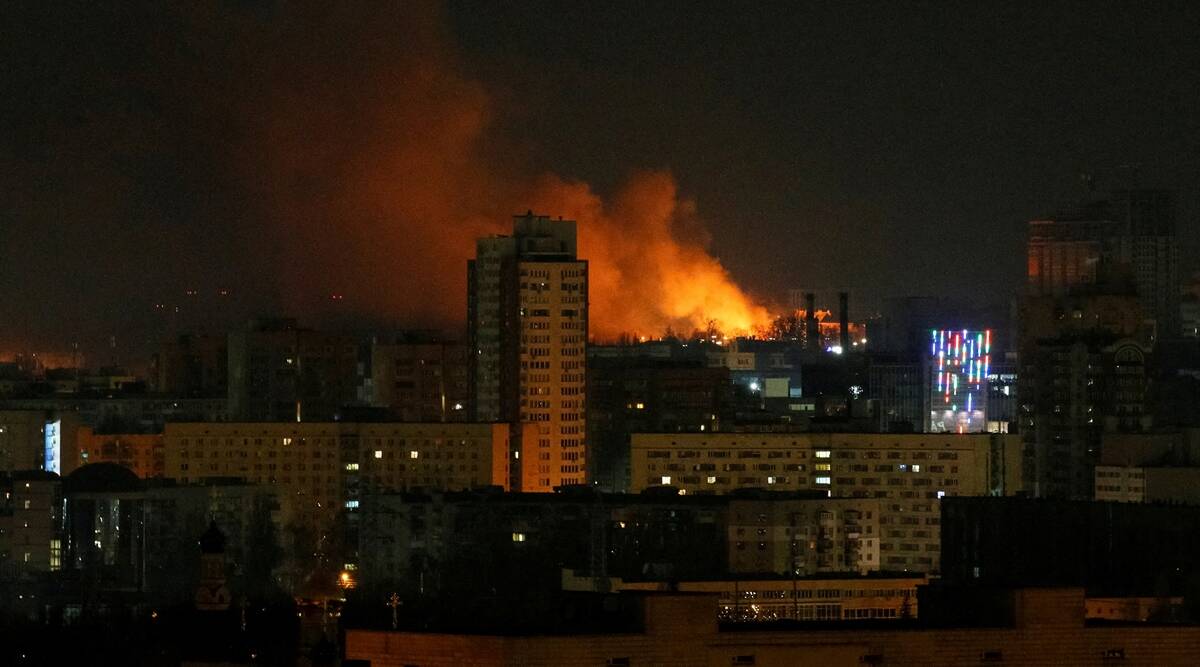
On February 21, 2022, Russia recognised the Ukraine rebel regions in Eastern Ukraine – Donetsk and Luhansk – as independent regions, despite calls from the West to put an end to the tensions driven by fears that Russia may attack Ukraine. This paved the way to provide them a direct challenge to the West that will fuel fears that Russia could imminently invade Ukraine.
Tensions have peaked over the last few weeks as Russia amassed over 1,50,000 troops at Ukraine borders in one of the worst crises since the Cold War. The announcement shatters a 2015 peace deal signed in Minsk requiring Ukrainian authorities to offer a broad self-rule to the rebel regions.
Ukraine has long played an important, yet sometimes overlooked, role in the global security order. Today, the country is on the front lines of a renewed great – power rivalry that many analysts say will dominate international relations in the decades ahead. In recent elections, Ukrainians have clearly indicated that they see their future in Europe, but the country continues to grapple with extreme corruption and deep regional rifts that could impede its path.
Meanwhile, Russia’s aggression in Ukraine has triggered the greatest security crisis in Europe since the Cold War. Though the US and its allies have taken significant punitive actions against Russia during the seven-year-old conflict, they have made little headway in helping to restore Ukraine’s territorial integrity.
A buildup of Russian military forces along the borders with Ukraine in late 2021 stoked fears that Moscow is preparing for a large scale invasion of its neighbor, although the Russia has denied this.
Historical background
Ukraine and Russia share hundreds of years of cultural, linguistic and familial links. For many in Russia and in the ethnically Russian parts of Ukraine, the shared heritage of the countries is an emotional issue that has been explained for electoral and military purposes. As part of the Soviet Union, Ukraine was the second-most powerful Soviet republic after Russia, and was crucial strategically, economically and culturally.
In 2013, Ukraine’s then-President Viktor Yanukovich, decided against signing an association agreement (AA) with the European Union (EU), sparking major pro- European protests in Ukraine. In February, 2014, the Ukrainian parliament voted to impeach Yanukovich, who fled Kyiv.
Subsequently, in March 2014, Russia annexed Crimea, an autonomous peninsula in southern Ukraine with strong Russian loyalties, on the pretext that it was defending its interests and those of Russian-speaking citizens. Shortly afterwards, pro-Russian separatists in Ukraine’s Donetsk and Luhansk regions declared their independence from Kiev, prompting months of heavy fighting. The EU, the US and other countries imposed sanctions on Russia. The EU-Ukraine AA entered into force in September 2017.
What are the Minsk Agreements?
In 2014 and 2015, a peace plan for Eastern Ukraine (the Minsk Protocol I & II) was signed, named after the Belarussian capital Minsk where the talks were held.
Minsk 1. Minsk 1 was written in September 14 by the Trilateral Contact Gp on Ukraine, i.e. Ukraine, Russia, and the Org for Security and Co-op in Europe (OSCE) with mediation by France and Germany in the so-called Normandy Format. Under Minsk 1, Ukraine and the Russia-backed rebels agreed on a 12-point ceasefire deal, which included prisoner exchanges, delivery of humanitarian assistance and the withdrawal of heavy weapons. However, due to violations by both sides, the agreement did not last long.
Minsk 2. As the rebels moved further into Ukraine, in February 15, representatives of Russia, Ukraine, the OSCE and the leaders of Donetsk and Luhansk signed a 13-point agreement , now known as the Minsk 2 accord. The new agreement had provisions for an immediate cease-fire, withdrawal of hy weaponry, OSCE monitoring, dialogue on interim self-government for Donetsk and Luhansk, in accordance with Ukrainian law.
It also had provisions related to acknowledgement of special status by parliament, pardon and amnesty for fighters, exchange of hostages and prisoners, humanitarian aid etc. However, these provisions have not been implemented because of what is popularly known as the ‘Minsk Conundrum’. This essentially means that Ukraine and Russia have contradictory interpretations about the agreement.
However, efforts to reach a diplomatic settlement and satisfactory resolution have been unsuccessful. A major blockage has been Russia’s insistence that it is not a party to the conflict and therefore is not bound by its terms. Since 2014, Ukraine has been witnessing shelling and skirmishes between the rebels and Ukrainian forces leading to the loss of over 14,000 lives by most estimates, creating around 1.5 million registered Internally Displaced Persons (IDPs) and destr of the local econ.
What has changed now is that the shelling has intensified since last October 21 when Russia began amassing troops along the borders with Ukraine. If the sit in the Donbass escalates, the possibility of a war cannot be dismissed. One way to prevent the outbreak of a war would be to implement the Minsk agreements immediately, as Russia has suggested.
(Tomorrow: Causes of conflict)
