



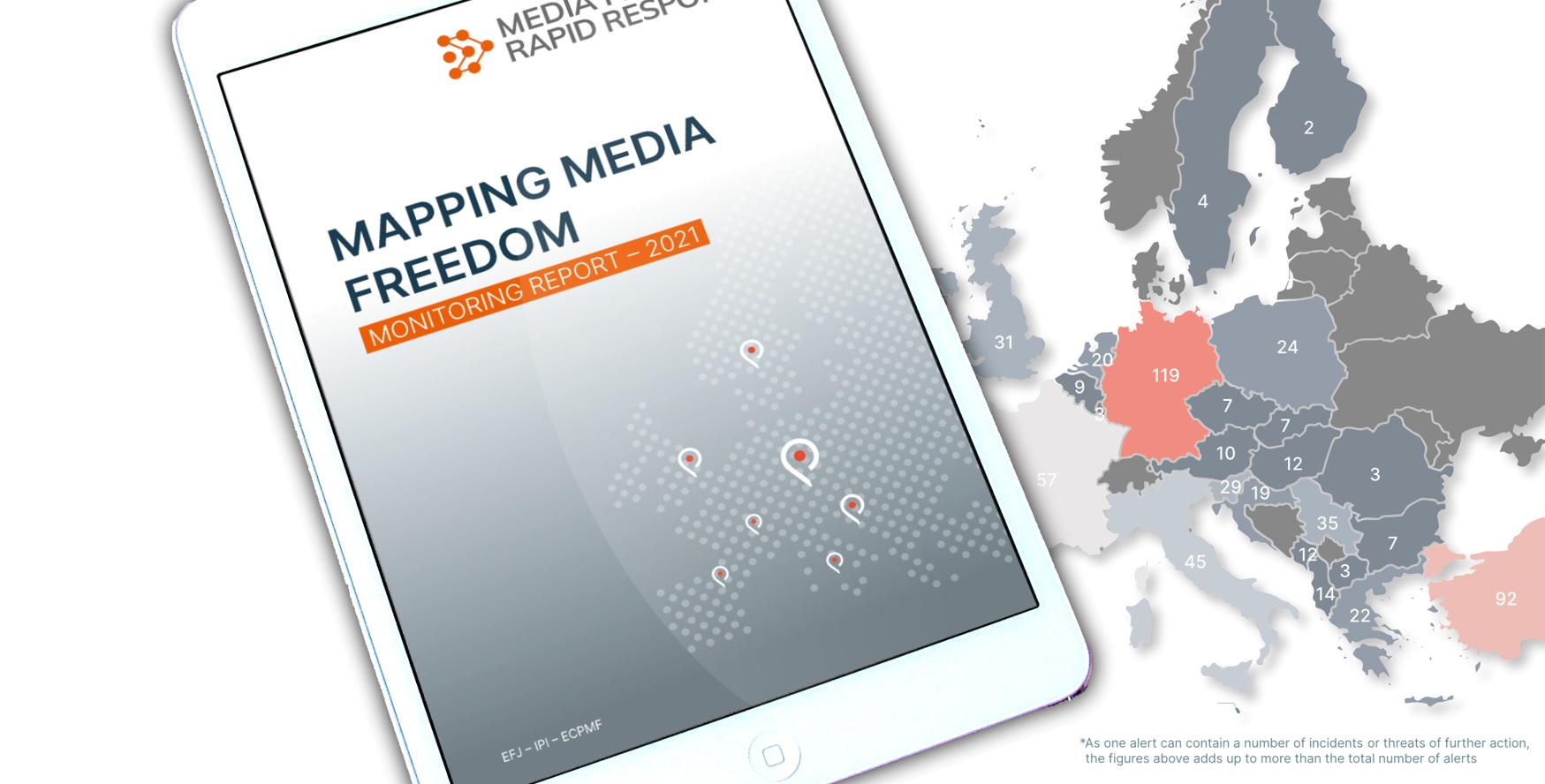
Attacked while covering demonstrations, harassed online for reporting on COVID-19 and measures to fight it, or sued by private companies trying to avoid publication of damaging information. These are just some examples of the threats received by journalists and media workers in Europe in 2021, mentioned in the annual report documenting systematic monitoring of media freedom violations across the region.
This was released by the International Press Institute (IPI) with its partners in the “Media Freedom Rapid Response (MFRR). Between January until December 2021, a total of 626 alerts were documented on Mapping Media Freedom (MapMF platform across EU Member States, candidate countries and the United Kingdom – ranging from physical attacks to SLAPP lawsuits and online harassment.
A total of 1,063 individuals or media entities in 30 countries were subject to one or more press freedom violations, including the murder of three journalists – underscoring the increasing threats to media freedom, journalist’s safety and independent journalism in Europe.
2021 was marked – as the previous year – by the consequences of the COVID-19 pandemic. More than one in four incidents (26.5% of alerts) were linked to the COVID-19, a figure comparable to the one in 2020 – 27.7%.
Many media freedom violations took place at protests and demonstrations – many held by anti-vaccine and anti-lockdown groups – where 178 alerts were recorded, 28.4% of the total. There was an increase in attacks taking place online, which rose from 14% of alerts in 2020 to 16,7% in 2021.
As for types of attacks, the most common included were verbal attacks (41.1%) such as intimidation, harassment or insults, followed by legal incidents (25.4%), physical attacks (21.1%), attacks to property (11.8%), and censorship (11.3%) such as arbitrary denial of accreditation or registration.
The report is divided in four main sections which offer quantitative and qualitative analysis of the main attacks perpetrated against journalists and media workers during the year. The first section provides a general picture and includes visualisations and statistics that summarise the data and explain the main findings of the monitoring project.
The analysis is followed by thematic reports focusing on two of the most relevant topics spotted by the monitoring partners throughout the year: attacks and threats linked to COVID-19 and online attacks. The third section focuses on country studies from the following states: Germany, Turkey, France, Italy, Serbia, Slovenia, Poland, Greece, the Netherlands, Spain, Albania, Montenegro, and Hungary.
