



* HRW annual report 2022
Though, the common view is that democracy around the world is on the decline, the Human Rights Watch 2022 Report noting how autocratic leaders faced significant backlash in 2021. But it questions, can democrats rise to the occasion?
The Theme of the report is that the failure of democratic leaders to effectively champion democratic values and rights is enabling the rise of autocrats worldwide.
In his introductory essay, Executive Director Kenneth Roth writes that autocratic leaders faced significant backlash in 2021, but democracy will flourish in the contest with autocracy only if democratic leaders do a better job of addressing global problems.
He argued that as people see that unaccountable rulers inevitably prioritize their own interests over the public’s, the popular demand for rights-respecting democracy often remains strong.
He asserted that there is a dire need for democratically-elected leaders to show bold and principled leadership in the face of global challenges like Covid and as anxiety over looming climate disaster grows.
Autocrats’ ability to act more quickly, unencumbered by the checks and balances of democracy, can paradoxically be their undoing. The free debate of democratic rule can slow decision-making, but it also ensures that diverse views are heard.
HRW’s more than 750-page annual report on rights abuses around the world, published Thursday, details intensifying crackdowns on opposition voices in places like China, Russia, Belarus and Egypt.
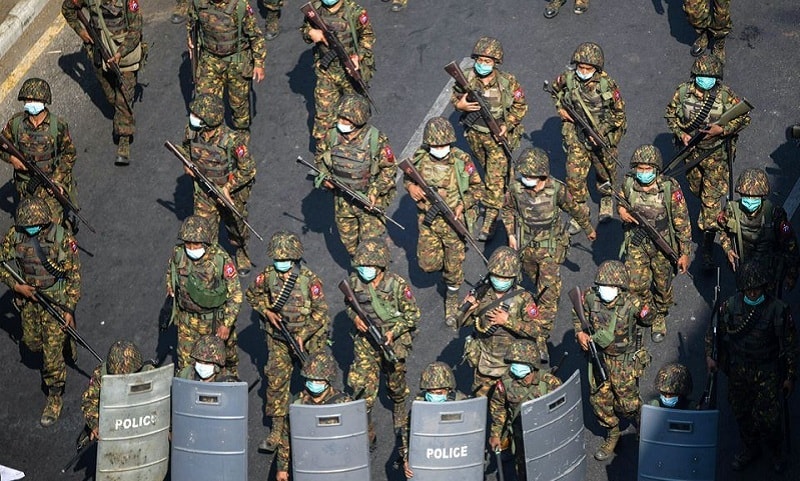
It also highlights several recent military coups, including in Myanmar and Sudan, and the emergence of leaders with autocratic tendencies in countries once or still considered democracies, such as Hungary, Poland, Brazil, India, and until last year, the United States.
HRW’s more than 750-page annual report on rights abuses around the world, details intensifying crackdowns on opposition voices in places like China, Russia, Belarus and Egypt.
It also highlights several recent military coups, including in Myanmar and Sudan, and the emergence of leaders with autocratic tendencies in countries once or still considered democracies, such as Hungary, Poland, Brazil, India, and until last year, the United States.Even when intrusive surveillance and severe repression ultimately curtailed demonstrations, the large numbers of people who joined them showed the public’s desire for democracy. Repression may yield resignation, but that should not be confused with support. Few people want the oppression, corruption, and mismanagement of autocratic rule.
US Democracy under threat
In contrast to Trump’s embrace of friendly autocrats when he was US president, Biden took office promising a foreign policy that would be guided by human rights. But he continued to sell arms to Egypt, Saudi Arabia, the United Arab Emirates, and Israel despite their persistent repression.
In the face of an autocratic trend in Central America, Biden mainly addressed the issue in traditional rival Nicaragua while elsewhere prioritizing efforts to curtail migration rather than autocracy. A preoccupation with migration also led Biden to tread softly with Mexican President Andrés Manuel López Obrador despite his attacks on the media and judiciary and his Covid denialism.
And even though efforts by former US president Donald Trump and his allies to overturn the results of the 2020 elections failed, Roth cautioned that US democracy is still “clearly being challenged today”.
Last year’s Capital riot by Trump supporters “was really just the beginning”, he said. Roth said he feared the January 6 riot was “a ham-fisted effort to overturn the elections, and now a much more sophisticated effort is underway, aiming for the next presidential elections.” “There is an urgent need to defend democracy in the United States.”
Stellar record in addressing societal ills
Yet democracies today hardly have a stellar record in addressing societal ills. It is widely understood that, ultimately, democracies rise or fall by the power of their example, but too often that example has been disappointing. Today’s democratic leaders are not rising to the challenges facing the world.
In country after country, large numbers of people have recently taken to the streets, even at the risk of being arrested or shot. There are few rallies for autocratic rule.
In some countries ruled by autocrats that retain at least a semblance of democratic elections, opposition political parties have begun to paper over their policy differences to build alliances in pursuit of their common interest in ousting the autocrat.
And as autocrats can no longer rely on subtly manipulated elections to preserve power, a growing number are resorting to overt electoral charades that guarantee their desired result but confer none of the legitimacy sought from holding an election.
Yet, autocrats are enjoying their moment in the sun in part because of the failings of democratic leaders. Democracy may be the least bad form of governance, as Winston Churchill observed, because the electorate can vote the government out, but today’s democratic leaders are not meeting the challenges before them.
Whether it is the climate crisis, the Covid-19 pandemic, poverty and inequality, racial injustice, or the threats from modern technology, these leaders are often too mired in partisan battles and short-term preoccupations to address these problems effectively. Some populist politicians try to divert attention with racist, sexist, xenophobic or homophobic appeals, leaving real solutions elusive.
Do more than spotlight the autocrats’
If democracies are to prevail in the global contest with autocracy, their leaders must do more than spotlight the autocrats’ inevitable shortcomings. They need to make a stronger, positive case for democratic rule. That means doing a better job of meeting national and global challenges—of making sure that democracy delivers on its promised dividends.
It means standing up for democratic institutions such as independent courts, free media, robust legislatures, and vibrant civil societies even when that brings unwelcome scrutiny or challenges to executive policies.
And it demands elevating public discourse rather than stoking our worst sentiments, acting on democratic principles rather than merely voicing them, unifying us before looming threats rather than dividing us in the quest for another do-nothing term in office.
Most of the world today looks to democratic leaders to solve our biggest problems. The Chinese and Russian leaders did not even bother showing up at the climate summit in Glasgow.
But if democratic officials continue to fail us, if they are unable to summon the visionary leadership that this demanding era requires, they risk fueling the frustration and despair that are fertile ground for the autocrats.
The outcome of the high-stakes battle between autocracy and democracy remains uncertain. Due to the tendency of unaccountable governments to deliver poorly for their people, the autocrats are on the defensive as popular protests mount, broad pro-democracy political coalitions emerge, and mere managed elections, as opposed to electoral charades, prove unreliable.
