



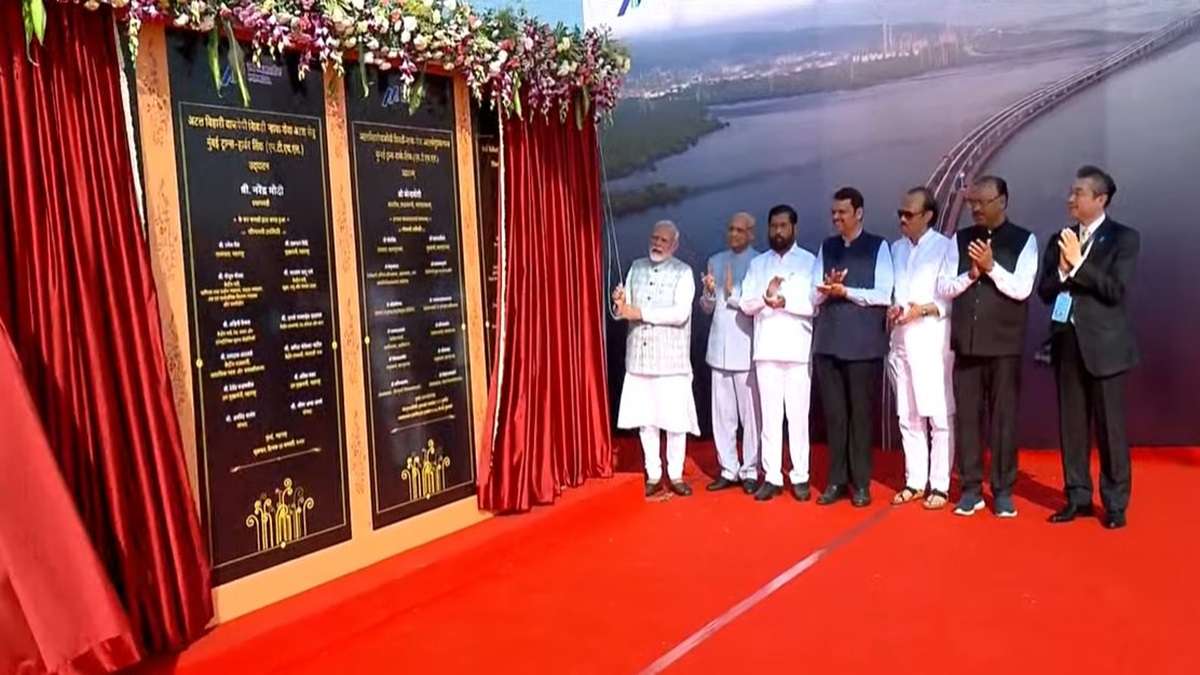
Prime Minister Narendra Modi, on Friday, inaugurated Atal Setu, the longest sea bridge in the country connecting Mumbai and its satellite township Navi Mumbai, and claimed that the project was the fulfillment of his guarantee.
The prime minister, who was on a day-long visit to Maharashtra and addressed various groups in the state, appeared to be sounding the Lok Sabha poll bugle when he hailed the Rs 17,840 crore Atal Bihari Vajpayee Sewri-Nhava Sheva Atal Setu—the longest bridge as well as the longest sea bridge in the country connecting south Mumbai with Nhava-Sheva in Navi Mumbai—a “picture of developed India,” and took on the opposition, questioning their loyalty.
The prime minister said before 2014, people used to discuss mega scams, but now, mega projects being completed are the topics of discussions. Harping on the theme of development, Modi said Atal Setu is a glimpse of what a developed India is.
“In a developed India, there will be facilities for all, there will be prosperity for all, there will be speed and there will be progress. In developed India, distances will be reduced and every corner of the country will be connected. Be it life or livelihood, everything will go on without interruption. This is the message of Atal Setu.”
Several developmental projects were inaugurated when Maharashtra, for the first time, got the double-engine government, he said and added that the Atal Setu is a result of combined efforts of the Central and State governments.
The upcoming projects, Navi Mumbai International Airport, the Coastal Road in Mumbai, AURIC (Aurangabad Industrial City), the Mumbai-Delhi Industrial Corridor, and the bullet train, will boost Maharashtra’s economy in the years to come, the prime minister said. Modi said Atal Setu is a testament that the BJP government delivers on its promises.
Hitting out at the opposition, he said the loyalty and intentions of those who ruled India for a long time were always under question. “Their intention was to gain power only. They were only dedicated towards the development of their families, and this is why they were never able to think about a developed India.”
